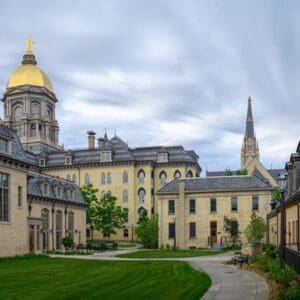
As a current Notre Dame Graduate student, I have the privilege of walking and biking around campus every day. One of the activities I have chosen to do with some classmates in some of my free time is something called “Tree140.” Simply put, I am spending 140 minutes this semester with a tree on campus, so that I can intentionally take in the beauty of creation that surrounds me.
As the leaves change colors, the temperature starts to drop, and cloudy skies start to loom over Notre Dame, I have come to notice the life that surrounds my particular tree. Many forms of life have made my tree their home, their own intricate castle. The ants that crawl around it, the bugs that fly around it, and the birds nesting in its branches, not to mention the tree itself, a bastion of life.
Jesus tells us in our gospel today that the kingdom of God is like a mustard seed, fully grown where the birds dwell in its branches. Jesus tells us that the kingdom of God is like this tree: A place full of life. However, Jesus tells us that even this falls short in comparison. How much more beautiful is the kingdom of God?
If I can learn what the kingdom of God is like by spending time with this tree, then it is all the more worth it. In some small way, I can experience the kingdom of God here on campus by being attentive to the images God shares with us in the world around us. If God is willing to speak to me through the image and experience of a tree, where else might we find him trying to speak to us?



 Karen Dehais