

Daily Gospel Reflection
Join the Notre Dame family of faith. Receive God’s Word and a unique reflection in your inbox each day.
October 2, 2026
The disciples approached Jesus and said,
“Who is the greatest in the Kingdom of heaven?”
He called a child over, placed it in their midst, and said,
“Amen, I say to you, unless you turn and become like children,
you will not enter the Kingdom of heaven.
Whoever humbles himself like this child
is the greatest in the Kingdom of heaven.
And whoever receives one child such as this in my name receives me.
“See that you do not despise one of these little ones,
for I say to you that their angels in heaven
always look upon the face of my heavenly Father.”
Excerpts from the Lectionary for Mass for Use in the Dioceses of the United States of America, second typical edition © 2001, 1998, 1997, 1986, 1970 Confraternity of Christian Doctrine, Inc., Washington, DC. Used with permission. All rights reserved. No portion of this text may be reproduced by any means without permission in writing from the copyright owner. The full readings of the day from the Lectionary are available here.
For anyone who has met my six-year-old son, humble would not be the first adjective to come to mind. Teddy confidently and regularly makes bold proclamations about being as strong as Superman or as fast as Lightning McQueen. In fact, if you turned to Teddy and asked, “Who is the greatest in the kingdom of heaven?” I bet he would answer, “I am!” before zooming away to stop another imaginary bad guy. With all the love a mother possesses, I wonder, “Would Jesus have pointed at this kid when telling me to humble myself like a child?”
When Teddy was two, he suffered his first seizure and, over the past four years, has been diagnosed with a rare and permanent form of epilepsy. That has meant enduring countless hospital visits, specialist referrals, an evolving cocktail of medications, and being on a specialized keto diet. It’s meant handing out Legos to our neighbors to give him on Halloween, explaining to every babysitter how his emergency medication works, and packing an extra cheese stick on days his classmates have birthdays so he can have a treat too.
What’s perhaps been most humbling to me in all of this, though, is realizing that Teddy can take on so much of what comes his way because of the complete trust he has in me. I feel the stress that comes with a delay in getting the next prescription refill. I carry the mental load of needing to precisely count and log the grams of everything he eats. I worry that he’s missing out on what feels like quintessential parts of being a little boy. But Teddy knows with confidence, or perhaps just doesn’t have to think about, that every meal we put before him is safe to eat.
While I often think of humility as a check on our ambitions or overconfidence, I wonder if humbling ourselves like a child may instead mean remembering to trust that our Father in heaven is carrying us—especially in the times we don’t see or appreciate now. May we all have the humility to accept the challenges that come our way without losing the joy and confidence of our most childlike selves, to truly be ourselves as God made us to be.
Prayer
Loving God—the shepherd who seeks us always. In your kingdom where the last are first and the first are last, may humility flow like a river to remove the pride that keeps us from being your children. May we trust in you alone. Grant this in the name of Christ our Lord and Brother. Amen.
Saint of the Day
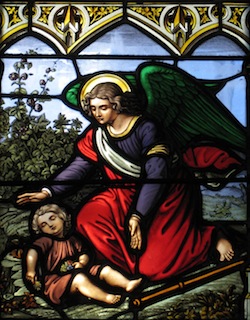
The idea of a guardian angel or a heavenly guide may seem superstitious, old-fashioned, or outdated to some. It is sometimes difficult to understand why Catholicism would include this rather fanciful idea in its Catechism. The teachings of the Catholic Church are not simply facts we blindly agree or disagree with, but rather are meant to reveal more to us about our God, who is love; the world God created; and how God seeks to offer us grace and salvation in every moment of our lives.
In its paragraph on guardian angels, the Catechism of the Catholic Church includes a quote from the great fourth-century theologian, St. Basil of Caesarea's treatise against Eunomius: “Beside each believer stands an angel as protector and shepherd leading him or her to life” (CCC 336). Basil's idea has some scriptural foundation, as Christ says: "Take care that you do not despise one of these little ones; for, I tell you, in heaven their angels continually see the face of my Father in heaven" (Mt 18:10).
The word “angel” comes from the Greek word angelos, a translation of the Hebrew word for “messenger.” Angels in Hebrew Scriptures function as spirits that bring messages from God—an angel brings word to Abraham to spare Isaac, an angel wrestles with Jacob, and angels help Daniel interpret God's visions. In the New Testament, the angel Gabriel announces the births of Jesus and John the Baptist, and angels assist Jesus when he is tempted in the desert and in his agony in the garden. In varying gospel accounts, angel(s) are witnessed at the empty tomb, and Matthew credits an angel with rolling the stone back from the entrance.
Who are these angels? What are they all about?
The branch of Christian theology that attempts to answer these questions, angelology, developed in the fourth century, beginning with Ambrose and Jerome, but really took off with the theologian Pseudo-Dionysius. Pope Gregory the Great developed his own hierarchy of the angelic choirs, and Thomas Aquinas discusses angels in his Summa Theologica. While their ideas about the nature and organization of angels vary somewhat, they agree on several key truths about angels. Angels are created spirits, having intellects and wills, but no bodies. Their presence in Scripture witnesses to a God who is an active agent operating in the world, but in ways that are still somewhat mysterious to human beings.
Angels are celebrated in the church's liturgical year on today's feast because the church desires to celebrate God's mysterious providence in creation. In the words of Pope Benedict XVI from his Angelus address on October 2, 2011, "the Lord is ever close and active in humanity’s history and accompanies us with the unique presence of his Angels. [...] From the beginning until the hour of death, human life is surrounded by their constant protection." Angels are yet another manifestation of the ever-provident care of our endlessly generous God who did not set creation in motion and leave it to its own devices, but who seeks, each day, to draw creation back towards the Divine Love from which it came.
This feast, which may be so uncomfortable to our scientific minds that want to reduce the world to explainable phenomena, reminds us that the physical world of our five senses is not the total of reality. Indeed, there are more things in heaven and earth, says Hamlet, "than are dreamt of in your philosophy." Creation comes from the God who is mystery, and creation is itself a mystery.
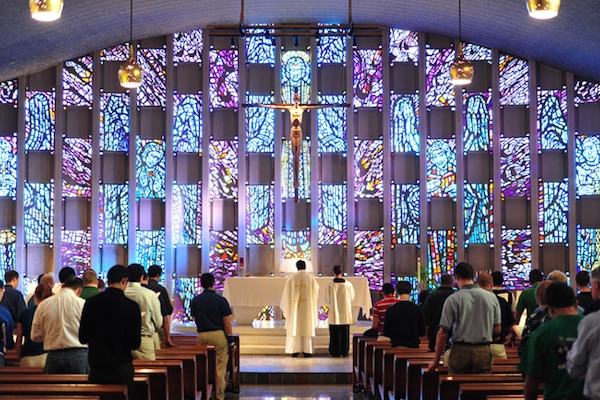
Angels are depicted in many places on Notre Dame's campus, most notably in the murals that decorate the Basilica of the Sacred Heart's richly painted ceiling. Several stained glass windows in the Basilica, such as the one above, portray angels as protectors and guardians of humans. Finally, the chapel of Moreau Seminary, shown above, features a stunning stained glass mosaic of angels behind the altar, which floods the church with light in both the morning and evening, reminding us of the constant care of God's angels for us, through all times and seasons of our lives.
Angel of God, be at my side to light, to guard, to rule and guide!