

Daily Gospel Reflection
Join the Notre Dame family of faith. Receive God’s Word and a unique reflection in your inbox each day.
September 13, 2026
Peter approached Jesus and asked him,
“Lord, if my brother sins against me,
how often must I forgive?
As many as seven times?”
Jesus answered, “I say to you, not seven times but seventy-seven times.
That is why the kingdom of heaven may be likened to a king
who decided to settle accounts with his servants.
When he began the accounting,
a debtor was brought before him who owed him a huge amount.
Since he had no way of paying it back,
his master ordered him to be sold,
along with his wife, his children, and all his property,
in payment of the debt.
At that, the servant fell down, did him homage, and said,
‘Be patient with me, and I will pay you back in full.’
Moved with compassion the master of that servant
let him go and forgave him the loan.
When that servant had left, he found one of his fellow servants
who owed him a much smaller amount.
He seized him and started to choke him, demanding,
‘Pay back what you owe.’
Falling to his knees, his fellow servant begged him,
‘Be patient with me, and I will pay you back.’
But he refused.
Instead, he had the fellow servant put in prison
until he paid back the debt.
Now when his fellow servants saw what had happened,
they were deeply disturbed, and went to their master
and reported the whole affair.
His master summoned him and said to him, ‘You wicked servant!
I forgave you your entire debt because you begged me to.
Should you not have had pity on your fellow servant,
as I had pity on you?’
Then in anger his master handed him over to the torturers
until he should pay back the whole debt.
So will my heavenly Father do to you,
unless each of you forgives your brother from your heart.”
Excerpts from the Lectionary for Mass for Use in the Dioceses of the United States of America, second typical edition © 2001, 1998, 1997, 1986, 1970 Confraternity of Christian Doctrine, Inc., Washington, DC. Used with permission. All rights reserved. No portion of this text may be reproduced by any means without permission in writing from the copyright owner. The full readings of the day from the Lectionary are available here.
Reflection
The willingness to forgive is among the most important aspects of the Christian life. In the Lord’s Prayer, we are instructed to “forgive those who trespass against us,” just as God forgives us of our trespasses. In the Prayer of St. Francis of Assisi, a personal favorite of mine, we are likewise reminded that “it is in pardoning that we are pardoned.” Up and down the centuries, our predecessors in the faith have told us that forgiving others is an important way to model our lives on Christ’s.
Of course, how one forgives a stranger might be different than how one forgives a friend or family member. But despite these differences, forgiveness has a universal feature about which we are reminded in today’s reading. That feature is that we all have been (and continue to be) forgiven, and therefore that we too must always forgive.
When Peter approaches Jesus to ask how often he must forgive, Jesus says that forgiveness should not be given seven times, but rather seventy-seven times. Implicit in Jesus’ response is a recognition that sinning against others and being forgiven for our own sins are hardly one-off events.
What does one do after experiencing this constant forgiveness? Today’s reading again provides an answer: forgive others. In the parable that Jesus conveys to Peter, a servant begs his master to forgive a debt; after the master forgives his debt, though, the servant refuses to forgive a fellow servant, prompting his master to rebuke him. Like the servant’s master, God asks us to respond to the experience of being forgiven by forgiving. Doing so enables us to pattern our lives ever better on that of Christ—who, even moments before his death, asked God to forgive those who crucified him.
Prayer
Lord God, in your great mercy you sent your Son to pour out himself for our sins. By his blood, he paid the price that we are unable to pay. May we always give thanks for so great a gift of love and may we in turn show your love and mercy to our neighbors. Give us the gift of your healing forgiveness to soften our hearts to be able to love as you do. We ask this in the name of Jesus Christ our Lord. Amen.
Saint of the Day
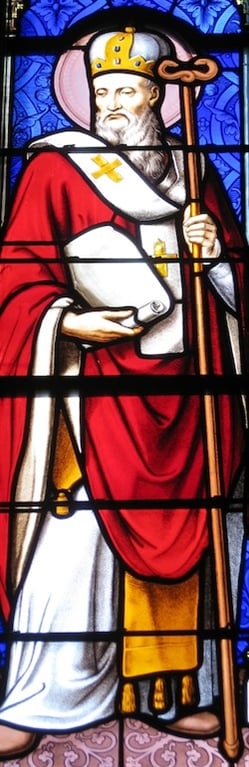
St. John Chrysostom is a doctor of the Church, a bishop from the fifth century whose fiery and powerful preaching earned him the name "Chrysostom," meaning “golden mouth.”
He was born in 347 in Antioch, Syria, the only son of a commander of imperial troops. His father died when he was still a child, thus John was raised by his mother, who modeled for young John a truly Christian life, devoting herself to a life of piety while upholding her family obligations.
John's mother provided the best education possible for her son, and John learned rhetoric from the master orator of Antioch, Libanius. Even as a young man, John outperformed the other students, and even surpassed his teacher in style and talent. In fact, as legend has it, Libanius was on his deathbed and asked who should follow him in leading the school. “John would have been my choice,” he said, “if the Christians had not stolen him from us.”
After completing his education, John poured his dynamic energy into pursuing a monastic life. He joined the community of hermits and monks living in the mountains near Antioch. John spent four years under close spiritual direction from a monk, and another two years living in solitude and prayer in a cave.
The harsh monastic diet of a hermit caused great harm to his stomach, forcing John to return to Antioch and plaguing him with ill health for the rest of his life. Upon his return to the city, he was ordained a deacon and assigned to assist the bishop with preaching at liturgy. For twelve years, he served the Christian community of Antioch through his preaching. Continually, he encouraged the Christians of Antioch to be a witness to their status-obsessed pagan neighbors and to provide radical love and hospitality to the poor. His homilies on Luke's parable of Lazarus and the Rich Man are particularly poignant examples. John Chrysostom was never afraid to venture into political territory during his homilies, and more than once he called out the imperial family on their lavish lifestyle and decadence. To John, Christianity was not simply a private affair in the hubbub of public urban life. In John's eyes, Christians were called to transform the metropolis.

In 398, John, against his wishes, was named bishop of Constantinople, the capital of the new Roman empire. As bishop, he scandalized the elite of the city through his Spartan lifestyle. Eschewing dinner parties and fine clothing, John provided for the poor and supported the relatively new invention of urban public hospitals. John particularly encouraged a Eucharistic devotion among his people, urging them to receive Communion as often as they could. John highlighted the Eucharist as the banquet of the heavenly city where rich and poor could meet as equals in Christ.
He was known for being able to speak to the hearts of people who felt stuck in sin—“If you have fallen a second time, or even a thousand times into sin,” he said, “come to me, and you shall be healed.” John converted many with his intuitive compassion for others, and his firm calls to repentance.
John spent his last years in exile for speaking out once too often against the sumptuous lifestyle of the Empress Eudoxia and the imperial capital. In revenge for his criticisms, the emperor and empress conspired with a faction of bishops who opposed John and had him removed from office and exiled deep into the region of Anatolia in present-day Turkey. Forced to march for three months to his exile, John suffered greatly on this journey, as the harsh elements and rough treatment taxed his already frail health. He kept up his correspondence until the end; his letters to his friend the deaconess Olympias are a precious record of his last days. He died on Sept. 14, 407.
John's storied last words to his congregation were: “Violent storms encompass me on all sides. Though the sea roar and the waves rise high, they cannot overwhelm the ship of Jesus Christ. I fear not death, which is my gain; nor banishment, for the whole earth is the Lord’s; nor the loss of things, for I came naked into this world, and I can carry nothing out of it.”

In 1204, crusaders looted his relics from Constantinople and bore them to Rome. In 2004, Pope John Paul II returned some of these relics to the Eastern Church. Other relics of his rest in the reliquary chapel in the Basilica, where he is also depicted in two stained glass windows. One of these windows shows him contemplating a vision of St. Paul, whose writings were a favorite subject of his preaching. Additionally, John Chrysostom is portrayed in a stained glass window in the library of Moreau Seminary, below a symbol for the Eucharist, which he encouraged devotion to among his flock.
An overwhelming number of John Chysostom’s homilies have been preserved throughout the millennia since his death. He is considered the greatest preacher in the history of Christianity. The liturgy most often celebrated by Eastern Rite Catholics and Christians comes from St. John Chrysostom's Eucharistic Prayer—his words have shaped liturgical worship for millions over many centuries. As a doctor of the Church, he joins the ranks of 37 other saints who are honored for how well they taught the faith in words and deed.
St. John Chrysostom, golden-mouthed doctor of the Church, who eloquently challenged your people to serve Christ in the outcast of society—pray for us!