

Daily Gospel Reflection
Join the Notre Dame family of faith. Receive God’s Word and a unique reflection in your inbox each day.
September 16, 2026
Jesus said to the crowds:
“To what shall I compare the people of this generation?
What are they like?
They are like children who sit in the marketplace and call to one another,
‘We played the flute for you, but you did not dance.
We sang a dirge, but you did not weep.’
For John the Baptist came neither eating food nor drinking wine,
and you said, ‘He is possessed by a demon.’
The Son of Man came eating and drinking and you said,
‘Look, he is a glutton and a drunkard,
a friend of tax collectors and sinners.’
But wisdom is vindicated by all her children.”
Excerpts from the Lectionary for Mass for Use in the Dioceses of the United States of America, second typical edition © 2001, 1998, 1997, 1986, 1970 Confraternity of Christian Doctrine, Inc., Washington, DC. Used with permission. All rights reserved. No portion of this text may be reproduced by any means without permission in writing from the copyright owner. The full readings of the day from the Lectionary are available here.
Today’s gospel serves as an important reminder that the life of faith will not be the same life for each of the faithful. Jesus contrasts the ascetic life of John the Baptist, known for eating bugs and wearing uncomfortable clothing, with his own relatively ordinary one.
For the vast majority of Jesus’ life, he was simply a carpenter from a small town. When he began his ministry, people questioned, “Is this not the carpenter’s son?” or “Can anything good come from Nazareth?” Yet he still lived those ordinary years with the most extraordinary love and perfection.
Many are called to religious life, a more John-the-Baptist-like existence that transcends what is considered normal in the world. Similarly, many are called to live in the world: to study, to work hard, to raise a family. This seems very commonplace, but to truly follow Christ, we cannot do everything just as the world expects. We must also be friends with the tax collectors and sinners. The life of faith is challenging, and it sets us apart and sometimes at odds with the ways of the world. But Christ gives us the strength, through prayer and the sacraments, to proclaim the gospel in the way we are called.
In closing, consider these two modern saints: Mother Theresa and Carlo Acutis. Mother Theresa lived a life of poverty in India that none of us will likely replicate, touching countless lives and bringing countless souls to Christ. Carlo Acutis loved computers and video games, but used his technological savvy to share the love of God.
Whether more like a Mother Theresa or a Carlo Acutis, let us live out our calling of radical love.
Prayer
Almighty God, in your Son we are given new hope, that through him all divisions can be healed, all sins forgiven, and trust restored. Watch over us and those we love, that we may always be a sign of your reconciling love in a world full of hurt and betrayal. We ask this through Christ our Lord. Amen.
Saint of the Day
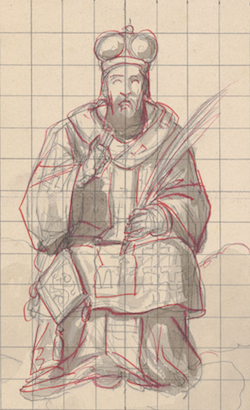
Sts. Cornelius and Cyprian were contemporaries and friends who supported one another in a time of ecclesial divisions and imperial persecution.
St. Cornelius was a priest in Rome during a period of intense persecution of Christians by the Emperor Decius in the mid-third century. During these persecutions, many Christians were martyred, including the Pope, Fabian. Some Christians chose to save their own lives by agreeing to make sacrifices to the Roman gods. Certain members of the Church at Rome held that these Christians could never be readmitted to the community of the faithful, regardless of their repentance. The leader of this position was the priest Novatian. Others believed that the lapsed Christians could return to the Church after a period of public penance. This contingent was led by Cornelius and, in North Africa, Cyprian.
While the persecutions raged on, it was impossible to elect a new Pope and the Church in Rome operated in hiding for more than a year. Eventually, Decius left Rome on a military campaign and the priests leading the community met in secret to elect a new Pope. Much to his surprise, Cornelius was chosen over Novatian. Cyprian wrote that Cornelius was elected, “by the judgment of God and of Christ, by the testimony of most of the clergy, by the vote of the people, with the consent of aged priests and of good men.”
In his brief papacy, Cornelius was able to cement his position favoring forgiveness for lapsed Christians through a council which he convened in Rome. The council condemned the rigorist position of the Novatians. Cornelius was arrested shortly thereafter in the ongoing persecutions. He was exiled in 251 and died in 253. Some early sources claim that he died from the hardship of banishment while later sources state that he was martyred by beheading.
St. Cyprian influenced the growth of the early Church, especially in Africa, where he was seen as the most important leader of the faithful in his time.
He was born in the year 200 in Carthage, and was raised without any particular religion. As an adult, he was active in the social and public life of Carthage as a teacher and lawyer. He came to know an older priest, Caecilian, who inspired him to explore the Christian life. Cyprian saw Caecilian as a father-figure and guardian angel. The priest returned the affection, and when he died, he entrusted the care of his family to Cyprian.
Under Caecilian’s care, Cyprian was baptized, reformed his life and took on a vow of chastity. His conversion to Christianity was so complete that he took on the study of Scripture and the saints who explained it.
He was soon ordained as a priest, and later was named bishop of Carthage. At first, he resisted the responsibility and tried to flee the town, but eventually relented and accepted the role. An early biographer described him as a charitable and courageous bishop who inspired respect and love.
A year after taking on his role as bishop, the Roman empire instituted a policy of persecuting Christians. A mob mentality ensued, and crowds called for Cyprian to be thrown to the lions. He fled and hid so as to continue to encourage the faithful in his care with letters. He wrote those who were imprisoned for their faith and organized priests to visit them to bring them holy Communion.
As in Rome, the Church in Carthage struggled to decide how to treat Christians who had renounced the faith during the persecution but wanted to return to the Church when others had suffered imprisonment or death. Cyprian was active in this debate, urging a strict policy, but enforcing it with mercy. He appealed to Pope Cornelius in Rome and two mutually reinforced the orthodox position of readmitting Christians to the community after penance.
A plague struck Carthage for several years between 252 and 254, and Cyprian did much to care for those who were suffering. He encouraged his flock to help the sick, whether they were Christian or not, and he especially urged the wealthy to offer their material resources. “Do not let something rest in your wallet that might be helpful for the poor,” he said.
The persecution of Christians intensified—laws prohibited the faithful from gathering and commanded bishops and priests to offer sacrifice to the imperial gods. Cyprian was arrested and sent into exile when he refused to renounce the faith. He was further condemned to death by beheading so as to be an example to others, and when his sentence was read, he replied, “Thanks be to God.”
Relics of St. Cyprian rest in the reliquary chapel in the Basilica, and this sketch of the saint is part of the collection of the Raclin Murphy Museum of Art. It is an early study prepared by the artist, Luigi Gregori, who painted the murals in the Basilica, though Cyprian was not included in the final group of saints who are depicted there.
Sts. Cornelius and Cyprian, in your friendship you protected the unity of the early Church and suffered under persecution for your faithfulness, pray for us!
Image Credit: Luigi Gregori (Italian, 1819-1896), Saint Cyprian, 1886, ink on paper. Raclin Murphy Museum of Art: Gift of Luigi Gregori, AA2009.056.330.