

Daily Gospel Reflection
Join the Notre Dame family of faith. Receive God’s Word and a unique reflection in your inbox each day.
September 27, 2026
Jesus said to the chief priests and elders of the people:
“What is your opinion?
A man had two sons.
He came to the first and said,
‘Son, go out and work in the vineyard today.’
He said in reply, ‘I will not,’
but afterwards changed his mind and went.
The man came to the other son and gave the same order.
He said in reply, ‘Yes, sir, ‘but did not go.
Which of the two did his father’s will?”
They answered, “The first.”
Jesus said to them, “Amen, I say to you,
tax collectors and prostitutes
are entering the kingdom of God before you.
When John came to you in the way of righteousness,
you did not believe him;
but tax collectors and prostitutes did.
Yet even when you saw that,
you did not later change your minds and believe him.”
Excerpts from the Lectionary for Mass for Use in the Dioceses of the United States of America, second typical edition © 2001, 1998, 1997, 1986, 1970 Confraternity of Christian Doctrine, Inc., Washington, DC. Used with permission. All rights reserved. No portion of this text may be reproduced by any means without permission in writing from the copyright owner. The full readings of the day from the Lectionary are available here.
Jesus’ words to the chief priests and elders that “tax collectors and prostitutes are entering the kingdom of God before you” are not just unsettling to these religious leaders. They can be difficult and confusing for many of us to hear. Does God not condemn the sins of greed and lust? Why does Christ seem to be praising those who engage in the very sins we are told to avoid?
The answer lies in the parable Christ tells immediately preceding these words. The first son is like the prostitutes and the tax collectors—he initially says “no” to doing God’s work. He turns away from God, as the prostitutes and tax collectors do when they fall into sin. But this “no” is not the end.
The first son changes his mind and goes out to do God’s work. This is conversion and repentance—despite his past sin, the first son returns to God. So too do the prostitutes and tax collectors when they repent and believe in God. Ultimately, they do not receive any special favors from Christ for being prostitutes and tax collectors, but are saved because they repent of their sins and believe in Christ.
In the course of our own lives, we will commit countless sins, some more grievous than others. But no matter how grievous we feel our sin is—even if we feel chained by mortal sin—we can always find forgiveness in Christ if we choose to repent. Like the first son in today’s gospel, let us pray for the humility to turn to God in our sin and seek God’s forgiveness, so that our faith is never a matter of mere outward appearance, but instead a life of obedience to God’s will.
Prayer
Like the second son in today’s gospel, Lord, we make promises that we do not keep. We get lazy or turn away from the work in the vineyard which you ask us to do. Please give us another chance when we stumble, and usher us one day into your kingdom. Amen.
Saint of the Day
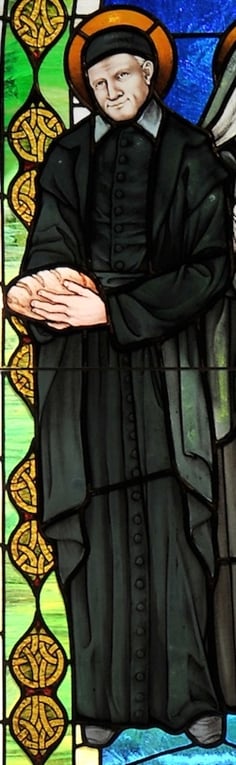
Initially aspiring to a life among the elite of France, St. Vincent de Paul transformed his life into advocating for the poor of Europe, and his name today is synonymous with care for the poor.
He was born on a small farm in southwestern France in 1581, the third of six children. From a young age, Vincent's quick mind and sharp intellect showed great promise. His parents ensured he received a good education from the Franciscan friars living nearby. Vincent went on to study at university and was ordained a priest in 1600, at the age of nineteen. The new regulations of the recent Council of Trent mandated twenty-four as the minimum age for ordination. Thus, Vincent had to step down from parish ministry and continue his studies when an ecclesial court protested his parish appointment.
As a precocious young man, Vincent aspired to accumulate wealth and guarantee a comfortable life for himself and his family at home. Vincent worked hard at university and found mentors in Pierre de Bérulle and André Duval, both premier theologians and churchmen.
A watershed moment in the trajectory of Vincent's life occurred when his friend and roommate was robbed. The roommate accused Vincent of the theft, slandering his name constantly. Vincent bore the slander with patient endurance, saying nothing more than, “God knows the truth.” The actual thief did not confess until years later, but this episode allowed patience and humility to flower in the ambitious young Vincent, establishing a new rule to guide his life.
Vincent continued his ministry among the elite and wealthy of France and received the special patronage of the Gondi family. While spending time with the Gondi family in the countryside, a peasant asked Vincent to hear his last confession. This encounter with the dying peasant opened Vincent’s eyes to the spiritual needs of the poor of France. He began to preach to and hear the confessions of the rural poor. The overwhelming response of the villagers to his outreach was so great that he had to call upon Jesuits living nearby to aid him in this ministry.
At the urging of the Gondis, King Louis XIII of France appointed Vincent chaplain of the galleys. This meant that Vincent ministered to a very different kind of congregation: to those prisoners of war and convicted criminals who were sentenced to row military ships. These men lived in terrible conditions—if they survived battles and the inevitable shipwreck, few lived more than a few years under their regimen of hard labor. Thus, Vincent continued to work among those on the margins of society by ministering to these men in harsh conditions.
The Gondi family felt called to fund more work among the poor, thus, in 1625, they convinced Vincent to establish a new community of priests who would care especially for the poor living in the country. The priests were called Fathers of the Mission (later known as Vincentians, after their founder). These new communities of priests emerging throughout Europe founded seminaries and colleges and continued to minister to those outside cities who had little access to the sacramental life of the church.
Vincent founded other religious orders and confraternities of charity which gathered Christian faithful to tend to the spiritual and physical needs of the poor. With Louise de Marillac, Vincent founded the Daughters of Charity, recognized for both their distinctive headpieces and the Miraculous Medal. With Louise and other collaborators, Vincent founded hospitals, orphanages, homes for the elderly, and other institutions to care for the poor throughout Europe.
Vincent continued to minister not only to the poor members of the Body of Christ, but also contributed to the Body of Christ's rich theological resources. Vincent wrote a spiritual guide for seminarians and initiated reforms to counter clerical abuses. He was appointed the spiritual advisor to King Louis XIII's widow, Anne of Austria, and helped her combat the Jansenist heresy which plagued France.
Through all of his work to build up God’s kingdom, Vincent maintained his patient and humble temperament. Vincent kept a record of his great spiritual task of converting his natural choleric and short temper to become tender and affectionate, befitting, he felt, a shepherd of God's people. His encounter with St. Francis de Sales had inspired him to become more "gentle and lovable." While God's grace does not destroy but rather perfects our natures, Vincent felt that a human could not make excuses for his or her own natural shortcomings, but rather seek to shape his or her personality into an image of Christ through humility and gentleness. Through his own work to conform more closely to a tender and loving God, Vincent channeled his iron temper into unflappable serenity and even-mindedness, even in the face of great adversity.
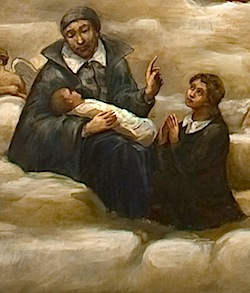
Thus, the once ambitious young cleric transformed his entire life into working more closely to become one with God. Speaking of his religious order, Vincent said: “Our highest ambition is to instruct the ignorant, to bring sinners to repentance, and to plant the Gospel spirit of charity, humility, meekness, and simplicity in the hearts of Christians."
In his later years, Vincent suffered a great deal from poor health, and he died on September 27, 1660. He is the patron of charities and philanthropic organizations, particularly the society that bears his name. His relics rest in the reliquary chapel in the Basilica of the Sacred Heart on campus. He is also depicted in the Basilica, on the mural adorning the ceiling of the Lady Chapel. Finally, Vincent is featured in a stained glass window in the chapel of Our Lady of Mercy in Geddes Hall, home of the Institute for Social Concerns.
St. Vincent de Paul, who served the poor with humility and gentleness—pray for us!