

Daily Gospel Reflection
Join the Notre Dame family of faith. Receive God’s Word and a unique reflection in your inbox each day.
September 3, 2026
While the crowd was pressing in on Jesus and listening to the word of God,
he was standing by the Lake of Gennesaret.
He saw two boats there alongside the lake;
the fishermen had disembarked and were washing their nets.
Getting into one of the boats, the one belonging to Simon,
he asked him to put out a short distance from the shore.
Then he sat down and taught the crowds from the boat.
After he had finished speaking, he said to Simon,
“Put out into deep water and lower your nets for a catch.”
Simon said in reply,
“Master, we have worked hard all night and have caught nothing,
but at your command I will lower the nets.”
When they had done this, they caught a great number of fish
and their nets were tearing.
They signaled to their partners in the other boat
to come to help them.
They came and filled both boats
so that the boats were in danger of sinking.
When Simon Peter saw this, he fell at the knees of Jesus and said,
“Depart from me, Lord, for I am a sinful man.”
For astonishment at the catch of fish they had made seized him
and all those with him,
and likewise James and John, the sons of Zebedee,
who were partners of Simon.
Jesus said to Simon, “Do not be afraid;
from now on you will be catching men.”
When they brought their boats to the shore,
they left everything and followed him.
Excerpts from the Lectionary for Mass for Use in the Dioceses of the United States of America, second typical edition © 2001, 1998, 1997, 1986, 1970 Confraternity of Christian Doctrine, Inc., Washington, DC. Used with permission. All rights reserved. No portion of this text may be reproduced by any means without permission in writing from the copyright owner. The full readings of the day from the Lectionary are available here.
Reflection
After witnessing a miraculous catch of fish in Luke 5:1–11, Simon Peter falls to his knees and tries to send Jesus away: “Depart from me, Lord, for I am a sinful man.” Faced with something extraordinary, Peter’s instinct is self-protection. He looks at his flaws and decides he isn’t qualified to be in the presence of the Lord.
I know that feeling all too well. As a woman with a career in a male-dominated field, every major career milestone was accompanied by a familiar whisper: Do I really belong here? Psychologists call it the impostor phenomenon, or the belief that our perceived inadequacy disqualifies us from the room we are standing in. At its core, this is exactly Peter’s impulse on the shores of Gennesaret.
For a long time, I viewed my self-doubt as a flaw to hide. But God does not waste our struggles. Jesus didn’t agree with Peter’s self-assessment, nor did he leave the boat. Instead, he said, “Do not be afraid,” redirecting Peter toward a larger mission. And for me, God took my isolation and self-doubt and transformed it into a calling toward mentorship and service. My struggles compelled me to step up for students and aspiring leaders on Notre Dame’s campus who feel the same way, walking alongside them to pave a smoother path forward. What I once carried as a heavy burden became the exact tool God used to cultivate empathy and purpose.
If I could speak to my younger self, or to anyone feeling unqualified today, I would remind them that when God places us in a room where we feel we don’t belong, God isn’t asking if we deserve the seat. God is asking if we will trust him enough to take it, and if we will be brave enough to leave the door open for those who come after us.
Prayer
Heavenly Father, you have given us all that is good. You constantly call us to put out into the deep in service to you and to one another. Give us the courage to listen to your commands, and to be fearless in our baptismal call to holiness. Help us to find ways to serve rather than to be served, even if those ways may be small or unseen by others. May we be faithful in our vocations to do your will rather than our own, and make you known, loved, and served. Amen.
Saint of the Day
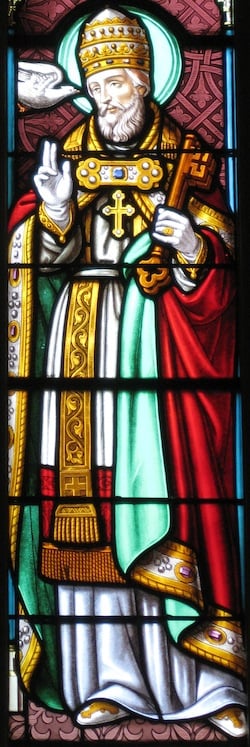
St. Gregory the Great was a civilian official before becoming a monk, a cardinal, and finally, one of the most influential popes the Church has ever known.
He was born in 540, the son of a wealthy Roman senator. He was educated by the best teachers in Rome, and when he was still a young man, the emperor named him chief magistrate of the city.
He filled this role for five years but clearly had other desires on his heart than his political career. When his father died, Gregory turned his home into a monastery and became a monk. He used his inheritance to build six other monasteries in the region.
When it came time to select a new pope, the faithful unanimously selected him by popular acclaim. As pope, Gregory was filled with zeal—he worked tirelessly and his contributions profoundly shaped the life of the Church.
As leader of the Church, he kept a close watch over the clergy and encouraged them towards holiness. He used papal money to ransom prisoners and to care for persecuted Jews and victims of famine and sickness. People of his day called him the father of the city of Rome, and the joy of the world.
He once observed English children being sold in the Roman Forum as slaves, and the sight made him decide to send missionaries to Canterbury—this was the beginning of Christianity among the Anglo-Saxons. He also sent missionaries to France, Spain, and parts of Africa during a time when Europe was being overturned by the Lombards, barbarian forces from the north. These efforts helped Christianize these forces—Gregory himself went to visit the king of the Lombards.
Gregory is known best for his contributions to the liturgy. He reformed the Mass and the daily prayer of the Church and wrote prayers we still use today as well as commentaries on Scripture that shaped theology through the Middle Ages. He also collected melodies of plain chant used in the liturgy—today that style is known as Gregorian chant, after him.

Gregory is one of the four great doctors of the Church, along with St. Ambrose, St. Augustine, and St. Jerome. These four and 34 other doctors have been singled out for their ability to articulate and teach the faith.
Gregory died in 604, and his relics rest in the reliquary chapel in the Basilica. He is patron of teachers and students, musicians and masons. He is depicted in several places on campus, here in stained glass from the Basilica and the second window from the chapel in Lyons Hall. He is often shown with a bird nearby—it is said that the Holy Spirit in the form of a dove spoke into his ear when he preached.
“The proof of love is in the works,” St. Gregory said. “Where love exists, it works great things. But when it ceases to act, it ceases to exist.”
Pope St. Gregory the Great, you were the monk who became one of the greatest popes ever—pray for us!