
Daily Gospel Reflection
Join the Notre Dame family of faith. Receive God’s Word and a unique reflection in your inbox each day.
September 30, 2026
As Jesus and his disciples were proceeding
on their journey, someone said to him,
“I will follow you wherever you go.”
Jesus answered him,
“Foxes have dens and birds of the sky have nests,
but the Son of Man has nowhere to rest his head.”
And to another he said, “Follow me.”
But he replied, “Lord, let me go first and bury my father.”
But he answered him, “Let the dead bury their dead.
But you, go and proclaim the Kingdom of God.”
And another said, “I will follow you, Lord,
but first let me say farewell to my family at home.”
Jesus answered him, “No one who sets a hand to the plow
and looks to what was left behind is fit for the Kingdom of God.”
Excerpts from the Lectionary for Mass for Use in the Dioceses of the United States of America, second typical edition © 2001, 1998, 1997, 1986, 1970 Confraternity of Christian Doctrine, Inc., Washington, DC. Used with permission. All rights reserved. No portion of this text may be reproduced by any means without permission in writing from the copyright owner. The full readings of the day from the Lectionary are available here.
Nestled in the back right corner of the Basilica of the Sacred Heart is a profound (yet often overlooked) side chapel. In this side chapel rests Ivan Meštrović’s Pietà, a sculpture of the dead Christ once he is taken down from the cross. However, Meštrović’s rendition is unique because it is not Mary holding Jesus, but rather Nicodemus.
Nicodemus’ expressions change based on the optical perspective at which you view this sculpture. From a frontal, eye-level view, Nicodemus looks angry, furious that Christ has been killed. Yet, if you place yourself underneath the sculpture on the singular wooden kneeler, Nicodemus is no longer angry, but rather, entirely saddened and devastated that Jesus has died. In my prayer underneath this sculpture, I have long likened the disposition of Nicodemus to that of God the Father: the Father, upset at the world for its ability to crucify the innocent Jesus, and yet profoundly saddened at witnessing the agony and grim death of the Son.
Meštrović’s Pietà leads us to our gospel today. In this gospel, Jesus makes extremely high demands. He is asking us to be willing to let go of everything and to orient our lives entirely towards him. He is asking us to pick up our cross and to hold nothing back. Surely, suffering will come when we take up these crosses. But we have a God who loves us so much that God has entered into our sufferings with us, a Father who has not spared the Son from death in order to save us.
And so, when we encounter these hard sayings of Jesus, let us pick up our crosses and firmly respond with the faith of Peter, saying, “Lord, to whom shall we go? You have the words of eternal life.” (Jn 6:68)
Prayer
Jesus Christ, our Lord and our God, you invite us to commit to you, each according to our capacity. Help us to embrace the opportunity to commit to you with all our hearts. Grant us the trust needed to follow you unreservedly that we may set all fear aside and enter into your joy. Amen.
Saint of the Day

A doctor of the church, Jerome was born 342 in what is now northeastern Italy. His father provided him with a good education, sending him to Rome to learn from the best teachers. His teachers were not Christian, however, and Jerome began to fall into habits of decadence that were the order of the day in Rome.
With friends, however, he would visit the tombs of the martyrs and apostles in church crypts or catacombs. Soon, Jerome was moved to devote his life to God.
In 374, Jerome settled in Antioch, the premier Christian city of Asia Minor. Jerome fell ill and had a delirious vision in which he stood before Christ in judgment and fell short because he had put rhetoric and study before faithfulness.
The experience touched him deeply, and he decided to retreat to live in the desert to seek holiness—he spent four years alone, focusing on prayer and fighting temptation with fasting, all the while suffering from poor health. His time in the desert focused his will and fired his passion for faithfulness, inspiring his eventual return to the city.
To distract his fiery will from temptation, Jerome dedicated himself to learning Hebrew from a fellow monk who had converted from Judaism. He found the Semitic language challenging, but he set his sharp mind to the task and persevered.
When he returned to Antioch, Jerome was ordained a priest, but felt drawn to the monastic life. He went to Constantinople to study Scripture under the great St. Gregory of Nazianzen. Later, he journeyed to Rome to attend a church council and was retained there by Pope Damasus I to be his secretary. At the pope’s request, Jerome retranslated and corrected the Latin version of the Greek Gospels, which had a number of errors in their transcription through the years.
Jerome possessed razor-sharp wits and often used pointed sarcasm to direct criticism at non-believers and other Christians with slack faith. “I never spared heretics and have always done my utmost that the enemies of the Church should also be my enemies,” he wrote.
Those who disliked him gossiped about him profusely, so Jerome decided to depart Rome for Palestine. He lived in a stone cave and opened a free school and hospice outside Jerusalem, near Bethlehem.
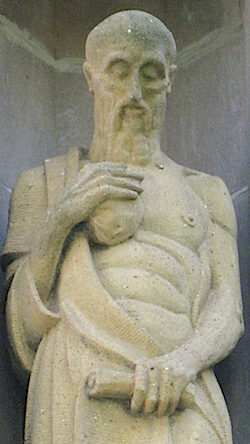
He continued to correspond with Church leaders, including St. Augustine, about certain heresies or distortions of the faith, quick to point out where error was present. Jerome's quick temper and salty tongue were only matched by his quickly converted heart. He is often depicted striking his breast with a stone (as in the statue here, from Dillon Hall) because he was as quick to repent as he was to convict.
He is known best for his work translating Scripture—the Church recognizes him as a great doctor of the church for his work translating not only the Gospels, but the entire Greek New Testament into Latin. Jerome translated both the Christian Scriptures and the Septuagint—the Greek translation of the Hebrew Scriptures—into what was the vernacular language of his day—Latin—thus his translation became known as the Latin Vulgate.
When Rome fell in 410, the wealthy elite that had slandered him were scattered. Many wandered through the Holy Land as beggars. Jerome interrupted his study and translation work to attend to their needs. “Today we must translate the words of the Scriptures into deeds,” he wrote. “Instead of speaking saintly words we must act them.”

Jerome died on this date in 420, and some of his relics rest in the reliquary chapel in the Basilica. He is depicted in stained glass windows in the Basilica as well, including one pane that shows him with a lion that represents his time as a desert hermit, as well as his fierce defense of the faith.
Jerome argued forcefully in support of the intercession of the saints who have died. He once wrote: “If the apostles and martyrs while still living upon earth can pray for other men, how much more may they do so after their victories? Have they less power now that they are with Jesus Christ?”
St. Jerome, the sarcastic holy hermit who defended the faith and diligently translated the words of Scripture—pray for us!