
Daily Gospel Reflection
Join the Notre Dame family of faith. Receive God’s Word and a unique reflection in your inbox each day.
September 8, 2026
This is how the birth of Jesus Christ came about.
When his mother Mary was betrothed to Joseph,
but before they lived together,
she was found with child through the Holy Spirit.
Joseph her husband, since he was a righteous man,
yet unwilling to expose her to shame,
decided to divorce her quietly.
Such was his intention when, behold,
the angel of the Lord appeared to him in a dream and said,
“Joseph, son of David,
do not be afraid to take Mary your wife into your home.
For it is through the Holy Spirit
that this child has been conceived in her.
She will bear a son and you are to name him Jesus,
because he will save his people from their sins.”
All this took place to fulfill
what the Lord had said through the prophet:
Behold, the virgin shall be with child and bear a son,
and they shall name him Emmanuel,
which means “God is with us.”
Excerpts from the Lectionary for Mass for Use in the Dioceses of the United States of America, second typical edition © 2001, 1998, 1997, 1986, 1970 Confraternity of Christian Doctrine, Inc., Washington, DC. Used with permission. All rights reserved. No portion of this text may be reproduced by any means without permission in writing from the copyright owner. The full readings of the day from the Lectionary are available here.
Saint Joseph was afraid. At the beginning of this summer, I was also afraid. Our fearfulness stemmed from places of uncertainty about the future. In this gospel, Joseph is being asked to take the vulnerable, pregnant Mother of Jesus into his home. This summer, I worked in a respite hospital for medically fragile children.
Families totally entrusted us with their severely disabled children in this home-like hospital. How could I worthily care for such precious children? How would I possibly begin to fill the role of their caregiver during the children’s week-long stays? Both Saint Joseph and I were gifted God’s most vulnerable children to take care of on a daily basis.
Just like Saint Joseph cared for Jesus, I bathed the children, fed them, played with them, and learned to communicate with them through ways beyond mere words.
As time went on, however, my fear dissolved and was replaced with a supernatural lens through which I saw Christ through them. I was no longer afraid, as Christ was with me. And this is what the gospel tells us today: “Do not be afraid.” God assures us that He is “with us.” These two simple phrases carry profound meaning and consistently surface throughout the Bible. In fact, “Do not be afraid” appears in the Bible 365 times. Is that a coincidence, given that a year is 365 days long? We need not be afraid of anything, for God is with us.
Saint Joseph perfectly exemplified how to combat fear in our daily lives. He took the Blessed Mother into his home to protect and care for her. Not only was Joseph tasked with caring for the Mother of God, but also God’s only begotten Son as well. God was literally and physically with Joseph, daily from that day onward.
Let us pray today for a stronger resolution to notice the times throughout our day when God is with us. Let us turn to our Lord whenever we may experience fear or anxiety of the future, asking Saint Joseph to intercede for us.
Prayer
Lord Jesus, the angel assured the loyal and faithful Joseph that the mother-to-be and her child, placed in his loving care, are our salvation. We thank you for the gift of your Son, of Our Blessed Mother, and of Saint Joseph, her most chaste spouse. We ask only that we can share in some way the love, respect, and faith of the Holy Family. This we ask through Christ our Lord. Amen.
Saint of the Day
Today, we remember the birth date of the one honored as the “God-bearer.”
Mary’s birth was the first realization of the promise of salvation through Jesus Christ. She was born without sin, pure and holy—“full of grace”—to prepare her to bear God’s Son to the world.
Among the saints, only Mary and St. John the Baptist have commemorations on the dates of their births and their deaths (or assumption to heaven, in Mary’s case). These two, above all other saints, heralded and participated in the arrival of our savior.
The birthplace of Mary is not known for certain. One ancient tradition holds that she was born in Nazareth. Another tradition states that she was born in Jerusalem in a neighborhood near the pool of Bethesda. Today there is a church in that neighborhood dedicated to St. Anne, Mary’s mother, and a crypt under that church designates a spot where Mary is believed to have been born. View images from that church in this part of our virtual pilgrimage to the Holy Land.
In the account of the first sin in Genesis, Eve was led astray by the figure of the serpent. Immediately upon discovering their sin, God said to the serpent, “I will put enmity between you and the woman, and between your offspring and hers; he will strike at your head, while you strike at his heel” (Gen 3:15).
Because the offspring of the woman lethally strikes at the serpent’s head, this passage is allegorically understood as the final triumph of good over evil. Here is the first promise of a redeemer for fallen humanity, Jesus, and the passage notes he is born of woman, Mary. With her obedience, Mary reverses Eve’s disobedience and brings life to the world through her Son, Jesus.

When Father Edward Sorin, C.S.C., arrived at a missionary outpost on the American frontier in northern Indiana in November of 1842, he saw a frozen lake covered in snow. The purity of the scene reminded him of Mary, and he named the university he founded after Our Lady of the Lake: the University of Notre Dame du Lac.
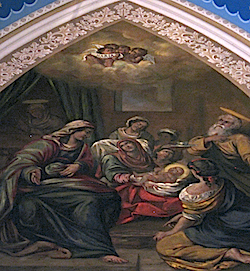
Images of Mary abound on campus, including a depiction of her birth in the mural shown above from the Basilica. Of course, she also appears atop the golden-domed Main Building, where she stands 19 feet high and weighs 4,000 pounds. Relics of Mary, including pieces of her clothes and hair, rest in the reliquary chapel in the Basilica.
Mary, Our Lady of the Lake, your obedience reversed Eve’s disobedience and brought life to the world—pray for us!