

Daily Gospel Reflection
Join the Notre Dame family of faith. Receive God’s Word and a unique reflection in your inbox each day.
March 16, 2026
At that time Jesus left [Samaria] for Galilee.
For Jesus himself testified
that a prophet has no honor in his native place.
When he came into Galilee, the Galileans welcomed him,
since they had seen all he had done in Jerusalem at the feast;
for they themselves had gone to the feast.
Then he returned to Cana in Galilee,
where he had made the water wine.
Now there was a royal official whose son was ill in Capernaum.
When he heard that Jesus had arrived in Galilee from Judea,
he went to him and asked him to come down
and heal his son, who was near death.
Jesus said to him,
“Unless you people see signs and wonders, you will not believe.”
The royal official said to him,
“Sir, come down before my child dies.”
Jesus said to him, “You may go; your son will live.”
The man believed what Jesus said to him and left.
While the man was on his way back,
his slaves met him and told him that his boy would live.
He asked them when he began to recover.
They told him,
“The fever left him yesterday, about one in the afternoon.”
The father realized that just at that time Jesus had said to him,
“Your son will live,”
and he and his whole household came to believe.
Now this was the second sign Jesus did
when he came to Galilee from Judea.
Excerpts from the Lectionary for Mass for Use in the Dioceses of the United States of America, second typical edition © 2001, 1998, 1997, 1986, 1970 Confraternity of Christian Doctrine, Inc., Washington, DC. Used with permission. All rights reserved. No portion of this text may be reproduced by any means without permission in writing from the copyright owner. The full readings of the day from the Lectionary are available here.
When I was 11, I sat in a church pew on a Wednesday night, begging God that if he let my brother live, I would not ask for anything ever again. My 24-year-old brother was in the ICU after collapsing two days prior from a brain aneurysm. Much like the Galileans, I was asking for a miracle. That prayer was not answered, and Steven passed away the following week.
At this vulnerable age, I could have been angry, confused, and hopeless; I could have stopped believing in God. But while my family experienced all stages of grief, we were counseled by our parish priest, who helped console us in our hour of need. He recommended the book, When Bad Things Happen to Good People, by Rabbi Harold Kushner. The book explores how God does not cause bad things to happen and gives us the strength to get through tragedies.
Oftentimes, when God does not do what we ask, we question if there is a God, if God loves us, or understands us. The truth that God does not abandon us but helps us when bad things happen has given my family great comfort during an inexplicable loss. Sometimes Jesus performs great miracles, as in today’s gospel, and sometimes God waits quietly, to help us when things just go wrong.
While it is challenging, we must try to remain steadfast in our faith when Jesus’ intervention does not provide direct healing. We must believe, even without the signs and wonders. It is difficult to understand that Jesus can perform miracles, but also does not heal or save everyone. However, I know I am not able to comprehend the depths of God’s hand in the world’s suffering. If we can hold on to our faith during the worst of times, we can see God present in our healing.
Prayer
Lord Jesus Christ, you are the word through whom all things came to be, and in whom all things live and move and receive new life. By your resurrection, transform the darkness of our minds. Let faith supply, where our senses fail. Take care of everything, for we surrender ourselves to you. Amen.
Saint of the Day
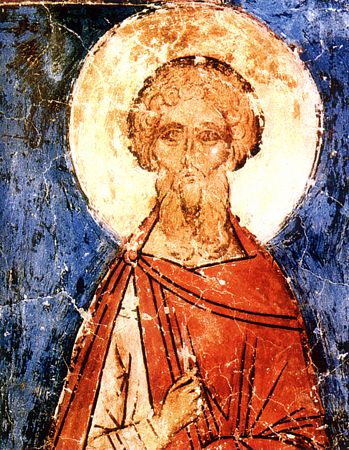
The relics of St. Julian were a powerful aid to prayer in the ancient world. The great “golden-tongued” preacher, St. John Chrysostom, used St. Julian’s life and example as a model for his congregations. Julian’s relics were known to be helpful in exorcising evil spirits.
Julian was a senator from Cilicia, which is in modern-day Turkey. He was arrested in 305 during a persecution of Christians and was subjected to many kinds of torture. He was even paraded around the region for a year as an example to other Christians. He was finally killed by being sewn into a bag full of snakes and scorpions and dumped in the sea. Whether or not this actually happened or is an exaggeration is difficult to tell, but suffice it to say that he suffered and met a painful death. His body was somehow recovered and transferred to Antioch.
One thing is clear: the people of Antioch in the fourth century had a very real and vigorous devotion to St. Julian, and relied upon his intercession. Antioch depended upon water travel for commerce, so perhaps his intercession was sought for sailors and those braving difficult voyages. After all, no voyage could be as terrible as one with snakes and scorpions for sailing companions. Some of St. Julian's relics rest in the reliquary chapel of the Basilica of the Sacred Heart on Notre Dame's campus.
St. Julian of Antioch, you were killed by being sewn into a bag full of snakes and scorpions—pray for us!
Image Credit: Our featured image of St. Julian of Antioch is in the public domain. Last accessed February 6, 2025 on Wikimedia Commons.
