
Daily Gospel Reflection
Join the Notre Dame family of faith. Receive God’s Word and a unique reflection in your inbox each day.
April 4, 2026
After the sabbath, as the first day of the week was dawning,
Mary Magdalene and the other Mary came to see the tomb.
And behold, there was a great earthquake;
for an angel of the Lord descended from heaven,
approached, rolled back the stone, and sat upon it.
His appearance was like lightning
and his clothing was white as snow.
The guards were shaken with fear of him
and became like dead men.
Then the angel said to the women in reply,
“Do not be afraid!
I know that you are seeking Jesus the crucified.
He is not here, for he has been raised just as he said.
Come and see the place where he lay.
Then go quickly and tell his disciples,
‘He has been raised from the dead,
and he is going before you to Galilee;
there you will see him.’
Behold, I have told you.”
Then they went away quickly from the tomb,
fearful yet overjoyed,
and ran to announce this to his disciples.
And behold, Jesus met them on their way and greeted them.
They approached, embraced his feet, and did him homage.
Then Jesus said to them, “Do not be afraid.
Go tell my brothers to go to Galilee,
and there they will see me.”
Excerpts from the Lectionary for Mass for Use in the Dioceses of the United States of America, second typical edition © 2001, 1998, 1997, 1986, 1970 Confraternity of Christian Doctrine, Inc., Washington, DC. Used with permission. All rights reserved. No portion of this text may be reproduced by any means without permission in writing from the copyright owner. The full readings of the day from the Lectionary are available here.
I imagine the women’s emotions are rather numb as they prepare themselves to perform the grim task of anointing the body of their friend and mentor—the thought of seeing Jesus lying there, lifeless. What sudden change of emotions must have come upon them when “there was a great earthquake.”
Every time I hear this passage, I put myself in the place of the other Mary. Perhaps I am waking up at the crack of dawn, meeting my friend to prepare for the cemetery visit to Jesus’ grave. This man, who had completely changed my life for the past three years with his radical teachings and miraculous healings, now lay dead in a cave. I feel devastated.
But when I get there, it’s not what I expected. An earthquake shakes the ground, and a giant rock moves seemingly on its own. And to top it off, an angel appears right before me and blinds me with glorious, heavenly light. I am terrified. But then the angel speaks: “Do not be afraid.” It is not an easy thing to do, but the power of heaven washes over me, and my fear is replaced with joy and excitement. I have to share this experience with everyone! And in my rush to go find the other disciples, who do I see but Jesus himself! He uses the same phrase as the angels, “Do not be afraid.”
In my own life, I have been very tired. I am going through treatment for breast cancer, and the radiation therapy has knocked me out good and proper. But the other day, my daughter called me from college just to say hello and that she loved me. That moment of family love changed my whole day, right at that moment. Absolutely invigorated!
May we each allow an unexpected gift in our day to energize us to share the good news: He is Risen! Alleluia!
Prayer
Almighty God of surprises, your plans and actions exceed not only our expectations, but also our imagination. Help us to remember not to seek the living among the dead. Open our eyes to notice experiences of darkness transformed into light, death to new life. As Mary, Joanna, and Mary were harbingers of joy and salvation, help us to be the same, through Christ our Risen Lord. Amen.
Saint of the Day
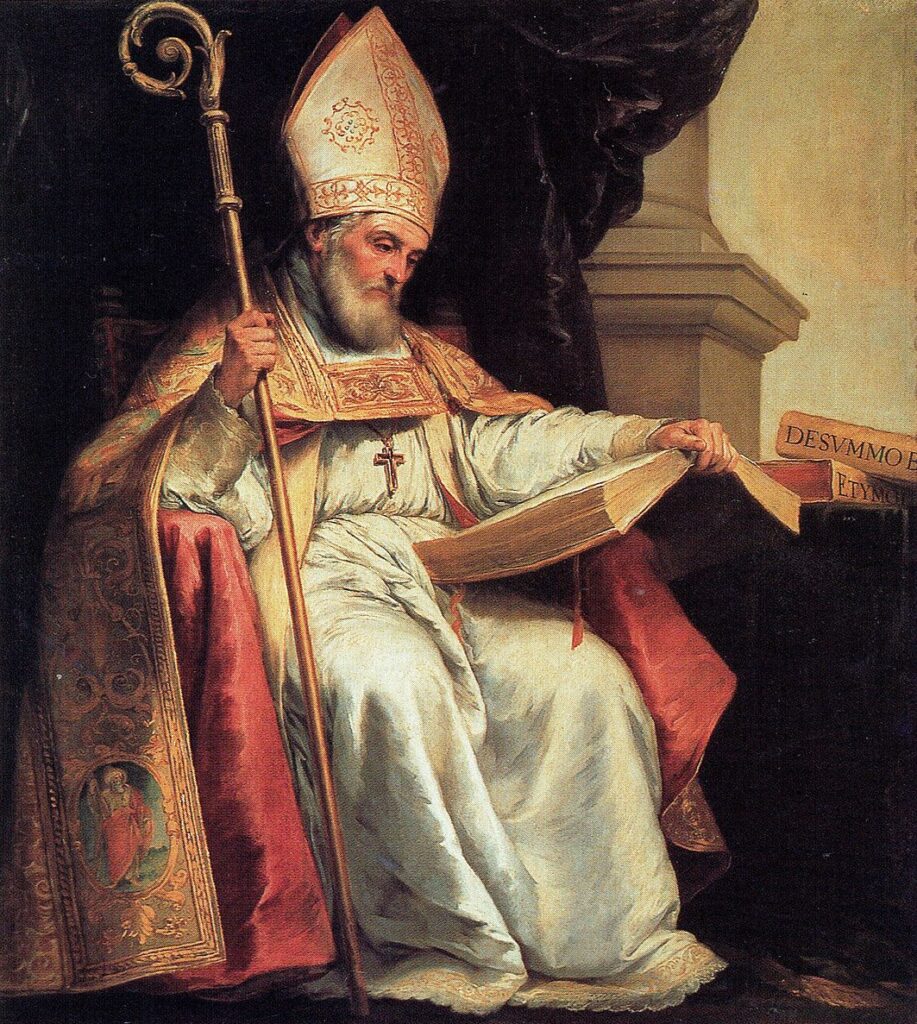
St. Isidore of Seville was Spain’s greatest teacher and is named a doctor of the Church.
He was born to a noble Spanish family in 560 AD and had two brothers and a sister who also became saints and took important leadership roles in the Church. Educated by his brother, Isidore discovered a love of learning that he transmitted everywhere he went. He helped his brother, who was a bishop, and later succeeded him as archbishop of Seville, where he served for 37 years.
As archbishop, he called for a seminary in every diocese and established a comprehensive educational system. In time, as Europe fell into the Middle Ages, Spain remained a center of learning and culture thanks to his vision to unite religion and learning. Under his leadership, schools in Spain taught liberal arts, medicine, law, Hebrew, and Greek. He even mandated teaching the works of Aristotle, which would not emerge in other areas of Europe for hundreds of years.
Isidore helped to govern the Church in Spain by calling councils. He rejected dictatorial decisions, and the representative councils he used for major decisions were a forerunner to the European parliamentary system.
His own learning was immense—he is known as the “schoolmaster of the Middle Ages.” He wrote an encyclopedia that was referenced for 1,000 years and produced works on astronomy, geography, world history, biographies, law, theology, and histories of various peoples.
Isidore lived to nearly 80 years old, and his piety and devotions increased the older he became. In his last months, his house was swarmed with poor people who knew they could receive help from him. One of the last things he did was to give everything he had to the poor.
St. Isidore was declared a doctor of the Church, a title given to 38 saints who are known for elucidating the faith by their words or example. Because of the universality of his knowledge, he is a patron saint of computers and the Internet, and his relics rest in the reliquary chapel in the Basilica of the Sacred Heart on Notre Dame's campus.
St. Isidore of Seville, your learning made Spain a beacon of light during the Middle Ages—pray for us!
Image Credit: Our featured image of St. Isidore of Seville is in the public domain. Last accessed February 17, 2025 on Wikimedia Commons.
