
Daily Gospel Reflection
Join the Notre Dame family of faith. Receive God’s Word and a unique reflection in your inbox each day.
June 9, 2026
Jesus said to his disciples:
“You are the salt of the earth.
But if salt loses its taste, with what can it be seasoned?
It is no longer good for anything
but to be thrown out and trampled underfoot.
You are the light of the world.
A city set on a mountain cannot be hidden.
Nor do they light a lamp and then put it under a bushel basket;
it is set on a lampstand,
where it gives light to all in the house.
Just so, your light must shine before others,
that they may see your good deeds
and glorify your heavenly Father.”
Excerpts from the Lectionary for Mass for Use in the Dioceses of the United States of America, second typical edition © 2001, 1998, 1997, 1986, 1970 Confraternity of Christian Doctrine, Inc., Washington, DC. Used with permission. All rights reserved. No portion of this text may be reproduced by any means without permission in writing from the copyright owner. The full readings of the day from the Lectionary are available here.
I am an introverted and shy person. Being the center of attention makes me uncomfortable, even anxious. The mere thought of all eyes being directed toward me can make me uneasy. Yet, I often find myself in precisely that position. As a priest, I must stand before the people. I say “must,” because it is part of my vocation.
When I preside at Mass, people naturally look toward the altar—toward me. Even now, after nearly two decades of priesthood, there is still a trace of nervousness, though much less than before. Perhaps I have simply grown accustomed to it. More importantly, I have come to realize something essential: the faithful are not truly looking at me—they are looking at Christ present in the ordained priest.
The universe offers a helpful image. Some celestial bodies are stars, like the sun, which generate their own light. Others, like the earth, do not shine by themselves. Yet this does not mean they are without light. The Earth reflects the light of the sun, and it also emits energy in other forms, such as infrared. We are not the stars. We are more like the earth. We do not produce the light on our own. Instead, we receive it—we reflect it—and we radiate what has first been given to us.
So too in the Christian life. We are not called to shine by our own power, but to receive the light of Christ and allow it to pass through us. When we do, it is not we who become the center of attention, but Christ who is seen in us—the light of the world.
And perhaps that is enough. We need not be nervous.
Prayer
Almighty and ever living God, your people long to taste and see the goodness of your love. Bless our hands and our wits that we might become your beacon of hope in a darkened world. Make our voice your own that your children may savor the presence of your promise and peace revealed in Jesus who is Lord forever and ever. Amen.
Saint of the Day
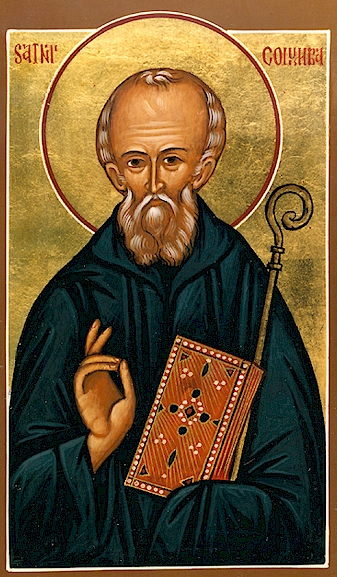
St. Columba is known as one of the "twelve Apostles of Ireland," and is a patron saint of Ireland and Scotland. Columba was a hard-nosed Irish abbot who was a great evangelizing force throughout the Celtic lands. This Celtic saint is sometimes called Columcille [Column - kill] because of the many “cells” or religious abbeys he established.
Columba was born in 521 in northern Ireland with royal lineage, and was educated at a local monastery where he was ordained a deacon. He went on to another town to study history and literature and developed into a poet. He completed his education and was ordained a priest at a famous monastery in Clonard, where he studied under St. Finnian, who was known as the tutor to Ireland’s saints.
Columba was a large and athletic man with a strong voice that carried well. He spent the next fifteen years traveling through Ireland, preaching and establishing monasteries.
Once, during a game of hurling (a game still played today), a player from Columba’s clan fatally injured another player and fled to Columba for protection. The opposing clan, ignoring the traditional right of sanctuary, dragged the man away from Columba and killed him in retribution. War broke out between the two clans, and 3,000 lost their lives in one battle. Columba was accused of instigating the war, and was held responsible for the dead.
Columba decided to repent for this violence by leaving his native Ireland and converting as many souls to Christ as had died in the war. With 12 companions—all related to him—he set sail in wicker, leather-covered currachs and landed on the island of Iona.
Columba built a famous abbey on Iona, which would become the center of his missionary activity for the rest of his life. It was situated between Picts of the north and the Scots in the south, and so was ideal for reaching out to both cultures. Columba traveled all over Scotland, converting souls to Christ and building the Church.
Columba remained connected to Ireland, traveling to Ireland multiple times to participate in councils, but he made the isle of Iona his home. People visited him there to seek healing in body or spirit, knowing that he was a holy man capable of miracles and prophecies.
One historian of the time wrote about Columba, “Of all qualities, gentleness was precisely the one in which Columba failed the most.” Yet he was known to be in constant prayer and projected serenity. He was polished and eloquent, and continued his study and learning through his whole life. He was known as a disciplined man who used severe austerities to deny himself, yet remained joyful and kind to everyone he met.
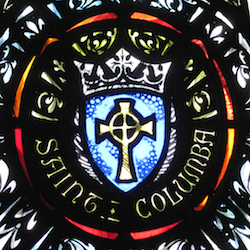
Columba died of an illness at an old age, and his relics rest in the reliquary chapel in the Basilica of the sacred heart on Notre Dame's campus. The small window pictured here carries St. Columba’s name around a Celtic cross and comes from the Dillon Hall chapel.
St. Columba, you became a missionary as a sign of repentance for starting a war—pray for us!
Image Credit: Our featured image of St. Columba is in the public domain. Last accessed March 11, 2025 on Wikimedia Commons.
.jpg)