

Daily Gospel Reflection
Join the Notre Dame family of faith. Receive God’s Word and a unique reflection in your inbox each day.
August 11, 2026
The disciples approached Jesus and said,
“Who is the greatest in the Kingdom of heaven?”
He called a child over, placed it in their midst, and said,
“Amen, I say to you, unless you turn and become like children,
you will not enter the Kingdom of heaven.
Whoever becomes humble like this child
is the greatest in the Kingdom of heaven.
And whoever receives one child such as this in my name receives me.
“See that you do not despise one of these little ones,
for I say to you that their angels in heaven
always look upon the face of my heavenly Father.
What is your opinion?
If a man has a hundred sheep and one of them goes astray,
will he not leave the ninety-nine in the hills
and go in search of the stray?
And if he finds it, amen, I say to you, he rejoices more over it
than over the ninety-nine that did not stray.
In just the same way, it is not the will of your heavenly Father
that one of these little ones be lost.”
Excerpts from the Lectionary for Mass for Use in the Dioceses of the United States of America, second typical edition © 2001, 1998, 1997, 1986, 1970 Confraternity of Christian Doctrine, Inc., Washington, DC. Used with permission. All rights reserved. No portion of this text may be reproduced by any means without permission in writing from the copyright owner. The full readings of the day from the Lectionary are available here.
In his sermon, The Weight of Glory, C.S. Lewis beautifully captures the force of Jesus’ teaching here: “There are no ordinary people. You have never talked to a mere mortal. Nations, cultures, arts, civilizations—these are mortal, and their life is to ours as the life of a gnat. But it is immortals whom we joke with, work with, marry, snub and exploit—immortal horrors or everlasting splendors. This does not mean that we are to be perpetually solemn. We must play. But our merriment must be of that kind (and it is, in fact, the merriest kind) which exists between people who have, from the outset, taken each other seriously—no flippancy, no superiority, no presumption.”
It is difficult to balance awareness of our immense dignity and the lightheartedness of childlike play, because as soon as we think about the balance, we become self-conscious. Imagine what this child may have felt as Jesus taught his disciples. Perhaps the child was embarrassed at being the center of attention. Or maybe the child was oblivious of what Jesus was doing and simply delighted at being in his presence. Certainly, the child felt loved, not only because Jesus is love incarnate, but also because Christ promised to be present to anyone who received the child.
The more the child focused on himself, the more self-conscious this event would have made him. The more the child focused on Jesus, the more the child would have been delighted. In relation to God, each of us is a child, mere creatures. But to avoid becoming self-conscious, we need to keep our focus on him. Everything we have, we have received as a free gift. And therefore, if we keep our focus on the giver, we can actually delight in the gift more freely than if we had earned it. So likewise, we can delight in each person, each child of God, because their whole being is a gift to us as well.
Prayer
Loving God—the shepherd who seeks us always. In your kingdom where the last are first and the first are last, may humility flow like a river to remove the pride that keeps us from being your children. May we trust in you alone. Grant this in the name of Christ our Lord and Brother. Amen.
Saint of the Day
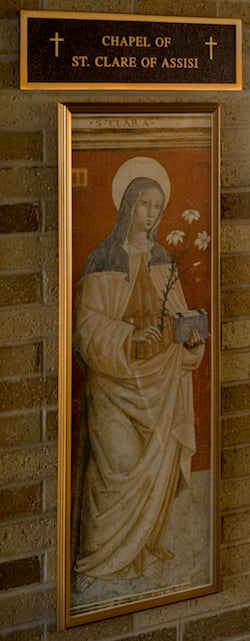
St. Clare was the most fervent follower of the great reformer, St. Francis of Assisi. She used this great zeal to establish the Franciscan Second Order religious community for women—the Poor Clares, who carry her name in honor of their foundress.
She was born in 1193 in Assisi. Clare came from a noble family—she was well-spoken and graceful. When she was 18 years old, Francis came to her church to preach during Lent. His words kindled a fire in her to follow his example of radical faithfulness to the Gospel.
She sought him out secretly for direction, and he encouraged her desire to leave all things for Christ. On Palm Sunday in 1212, she ran away from home and joined the small band of men who were gathering around St. Francis. They welcomed her at the door to their chapel, where St. Francis gave her a rough tunic made of sackcloth and cut off her hair as a sign of renunciation of the world.
Francis placed Clare with a nearby community of Benedictine sisters. When her family learned of her decision, they came to retrieve her. She stood steadfast and went to the chapel altar and grabbed hold of it. The story goes that they tried to physically remove her, but she clung so fast that they only succeeded in pulling off her clothes.
When her sister, Agnes, joined her, Francis placed the siblings in a small shelter next to the church where he was living and appointed Clare the superior. Others came to share in their life, including Clare’s mother eventually, and Clare established monasteries for the growing community throughout Italy and Germany. They are known today as the Poor Clares.
Clare adopted Francis’ love of poverty and humility, and her community followed her example. They wore nothing on their feet, slept on the ground, fasted from meat, and observed the discipline of silence as much as possible.
Clare was known to go even further in her mortifications—she wore a hairshirt and intensified her fasting by eating only bread and water during Lent, and some days ate nothing at all. Over time, with encouragement from Francis, she learned discretion and balance in her disciplines and urged the same from those who followed her.
Clare led her community for 40 years as the superior, but she sought the most menial tasks. When her sisters returned from begging for sustenance, she washed and kissed their feet. She served at the table during meals and helped the sick. She stayed up late in prayer, and when others had gone to sleep, she would check on them and tuck them in if their blankets had come loose.
People noticed extraordinary holiness in Clare—they saw her face shining brightly after she had spent time in prayer. Her intercession is credited with saving Assisi during several military campaigns.
She spent the last 27 years of her life suffering from illness, and when she was frequently confined to bed, she would sew fine linens for altars in the churches of Assisi. She had a special devotion to the Blessed Sacrament.
Her illness took a life-threatening turn in 1253. When it was clear that she would not recover, her community gathered around her, weeping. She told them, “Go forth without fear, for God who created you has sanctified you, has always protected you, and loves you as a mother. Blessed be you, O God, for having created me.”
She died on this date, and her relics rest in the reliquary chapel in the Basilica, where she is also depicted in stained glass. The chapel in Pasquerilla West is named after her, and her image appears there as well.
St. Clare, you followed St. Francis’ radical faithfulness to the Gospel and led other women to do the same—pray for us!