

Daily Gospel Reflection
Join the Notre Dame family of faith. Receive God’s Word and a unique reflection in your inbox each day.
September 21, 2026
As Jesus passed by,
he saw a man named Matthew sitting at the customs post.
He said to him, “Follow me.”
And he got up and followed him.
While he was at table in his house,
many tax collectors and sinners came
and sat with Jesus and his disciples.
The Pharisees saw this and said to his disciples,
“Why does your teacher eat with tax collectors and sinners?”
He heard this and said,
“Those who are well do not need a physician, but the sick do.
Go and learn the meaning of the words,
I desire mercy, not sacrifice.
I did not come to call the righteous but sinners.”
Excerpts from the Lectionary for Mass for Use in the Dioceses of the United States of America, second typical edition © 2001, 1998, 1997, 1986, 1970 Confraternity of Christian Doctrine, Inc., Washington, DC. Used with permission. All rights reserved. No portion of this text may be reproduced by any means without permission in writing from the copyright owner. The full readings of the day from the Lectionary are available here.
The call of Saint Matthew teaches us that the Christian life is very simple. When Jesus sees sinful Matthew, he does not tell him to reform his life or give to the poor. He tells him only, “Follow me.” For the sinner like Matthew, this is very good news. Despite a life of sin, he can turn and follow Christ immediately, trusting that everything else will fall into place. To be a disciple of Jesus, to be a Christian, only one thing is necessary: follow Jesus.
But this good news has a challenging flipside, as the Pharisees show us. While Jesus’ words to the sinner demonstrate that there are no prerequisites to being a disciple, his words to the Pharisees show that there is no substitute either. Our own righteousness, without Jesus, cannot save us. Being a “good person” alone is not enough because, in truth, we are all sinners. To be a disciple of Jesus, to be a Christian, only one thing is sufficient: follow Jesus.
All of us are the same before God in this—we all stand in dire need of the only thing that can truly make us happy, the only thing that can truly save us. The call of Matthew teaches us that the one thing necessary, and the one thing that suffices, is Jesus himself.
Prayer
“Follow me.” Lord, you spoke two simple words and they changed Matthew’s life forever. You speak those same words to each one of us, “Follow me,” and our response changes our lives forever. Thank you for inviting us to follow you. Like Matthew, the tax collector, help us know our own sickness and thus our great need for you. Help us to know our need for your mercy which you give to us freely and without reservation. We pray this through Christ our Lord. Amen.
Saint of the Day
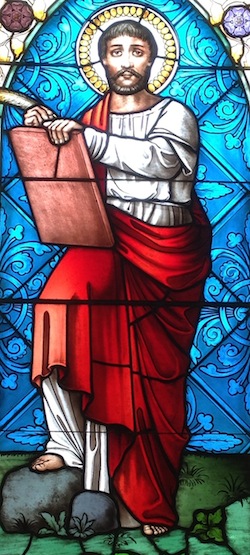
Despite his role as a despised tax collector, St. Matthew was called by Jesus to become one of his closest followers.
All tax collectors were hated in Judea because they were greedy and extortionist. Jewish tax collectors like Matthew were especially reviled because they gathered taxes for the occupying and oppressive Roman government. Jewish families generally refused to marry into a family that claimed a tax collector among them. Tax collectors were excluded from religious worship and barred from business and civil affairs.
Yet, Jesus passed by Matthew’s customs post and said to him, “Follow me.” And Matthew got up and followed him (Mt 9:9).
Matthew’s post was in Capernaum, where, for a time, Jesus had lived, preached, and worked miracles, so we can assume that Matthew had heard of Jesus and perhaps even listened to him before their encounter. Perhaps Matthew secretly longed to give his life over to the kingdom of God described by this man who worked wonders. When he finally came face to face with Jesus, he jumped at the chance—the personal invitation from Jesus must have been the opportunity Matthew was looking for. He left everything—his occupation and his relationships—in an instant.
Matthew was counted among the 12 disciples, and is traditionally cited as the author of a book of the Gospels.

The four evangelists are depicted by symbols that come from Ezekiel and the book of Revelation. John is represented by the eagle because his Gospel begins with high-minded, soaring theology of the Word made flesh. Mark is depicted by the lion because his Gospel begins with John the Baptist crying out in the wilderness (like a lion); Jesus also often appears with royal, king-like dignity in his Gospel. Luke is shown as an ox because of the importance of sacrifice in his Gospel. Matthew is symbolized by a man or angel because he begins the Gospel with the genealogy of Jesus, emphasizing his humanity.
A number of relics of St. Matthew rest in the reliquary chapel in the Basilica, where he is also depicted in several places. St. Matthew is also shown in this stained glass window from the chapel of the Stayer Center for Executive Education because he is patron saint of those who work with finances. This small window in the Morrissey Hall chapel (above) shows the saint as well.
St. Matthew, you were the reviled tax collector who became patron saint of those who work with finances—pray for us!