
Daily Gospel Reflection
Join the Notre Dame family of faith. Receive God’s Word and a unique reflection in your inbox each day.
October 22, 2026
Jesus said to his disciples:
“I have come to set the earth on fire,
and how I wish it were already blazing!
There is a baptism with which I must be baptized,
and how great is my anguish until it is accomplished!
Do you think that I have come to establish peace on the earth?
No, I tell you, but rather division.
From now on a household of five will be divided,
three against two and two against three;
a father will be divided against his son
and a son against his father,
a mother against her daughter
and a daughter against her mother,
a mother-in-law against her daughter-in-law
and a daughter-in-law against her mother-in-law.”
Excerpts from the Lectionary for Mass for Use in the Dioceses of the United States of America, second typical edition © 2001, 1998, 1997, 1986, 1970 Confraternity of Christian Doctrine, Inc., Washington, DC. Used with permission. All rights reserved. No portion of this text may be reproduced by any means without permission in writing from the copyright owner. The full readings of the day from the Lectionary are available here.
As a priest, I have often noticed that whenever I have proclaimed this text at Mass, people involuntarily recoil. Even I do sometimes. It keeps us guessing at the purpose of Jesus for using such language, which, for good reason, may move us not to identify with him. But precisely in these uneasy expressions, Jesus shares with us a spiritual principle that we so need in our time.
While I was a seminarian in Nigeria, I had a friend. He was very dear to me. To say it simply, he
was family. At a point, he started drifting away from values we held dear, bordering on faith and
good conscience. I had the words that the invitation of the gospel bids me to share with him, but
I was hesitant to do that. In those days, I was taken over by concern over our friendship should I
have shared with him the truth that burned in me. At that initial stage, I chose the easier option. I
chose to keep to myself, to remain nice towards him rather than disrupt the peace of our
friendship with the truth that he needed to hear. In that moment, I defined God’s invitation to
Christian witnessing with my attitude not to offend, not to break peace. It is to situations
like this that Jesus speaks to in this gospel.
How often do we define the invitations of our Christian vocation by our disposition to be merely
nice? It is genuine to be nice, but the vocation of a Christian is beyond that. We stand in the
world as embodiments of this fire that Jesus desires that it was already blazing; the fire of truth,
the fire of love, the fire of holiness.
With a tone of urgency, Jesus invites us to embody the virtues of goodness and truth to the world. On September 24, in St. Louis, Missouri, the church bore witness to a pastor who did just this, Blessed Fulton Sheen. He heard the invitation of the gospel and understood that it needed to be preached, and that he did with boldness. May we come to such realization in our lives.
Prayer
Father all-powerful, you sent the Holy Spirit into the world to set our hearts on fire. May the grace we receive through your Spirit help us to heal the divisions that separate us from our brothers and sisters. Help us to be zealous advocates of your undying love for humanity, so that all people will work to make you known, loved, and served. We make this prayer through Christ, our Lord. Amen.
Saint of the Day
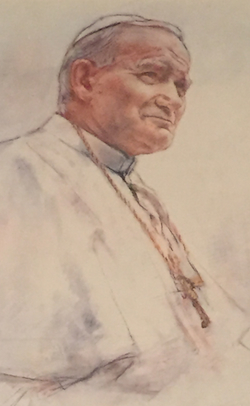
Pope John Paul II helped define the Church’s engagement with the world after the Second Vatican Council. His abundant charisma was matched only by his immense intellectual gifts, which he put at the service of fighting for human dignity and freedom. As the turmoil of the twentieth century gave way to the twenty-first, John Paul II fought to keep Christ the center of the human race's yesterday, today, and tomorrow.
Karol Jozef Wojtyla was born in Wadowice, Poland to a faithful Catholic family. Tragically, the young Karol was an orphan by the time he was twenty-one, having lost his mother, father, and his older brother. During World War II, during oppressive Nazi occupation, Karol enrolled in an underground seminary in Krakow and ran a resistance movement of artists. After the war ended, Karol was ordained a priest in 1946. He was sent for further education in Rome, to study at the Angelicum under the tutelage of a famous French Dominican theologian Fr. Garrigou-Lagrange.
The Communist regime that occupied Poland after World War II kept an eye on the brilliant young priest but underestimated him as a harmless intellectual. Thus, they allowed his appointment as an auxiliary bishop of Krakow in 1958. Karol attended sessions of the Second Vatican Council and contributed significantly to the ecumenical discussion. The experience of the council changed him and deepened his commitment to renewing the Church. He was named archbishop of Krakow in 1964, elevated to a cardinal in 1967, and provided leadership to the faithful of Poland as they faced persecution under Communist rule.
When Pope Paul VI died on August 6, 1978, Wojtyla went to Rome to elect a new pope. The cardinals elected Cardinal Albino Luciani of Venice, who took the name John Paul to honor the two popes who preceded him and who had guided the Second Vatican Council (John XXIII and Paul VI) . When Pope John Paul died after 33 days in office, the cardinals gathered once again, and this time, they elected Wojtyla, who took the name John Paul II as a symbol of continuity. He was the first non-Italian elected as Supreme Pontiff in 455 years.
When he stepped out onto the balcony facing St. Peter’s Square, his first words were these:
"Be not afraid! Open up—no, swing wide the gates to Christ. Open up to his saving power the confines of the state, open up economic and political systems, the vast empires of culture, civilization and development... Be not afraid!"
In the midst of the trauma of the second half of the twentieth century, and in the wake of great changes in the Church in the Second Vatican Council, there was a deep need for a wise leader to guide the Church and the world through the chaotic decades of rapid change. John Paul II ministered to Catholics in Soviet Bloc countries and continued to expand the pastoral reach of the papacy into the global South and East. Aided by immense energy and unflagging evangelical enthusiasm, John Paul II traveled on apostolic journeys to 124 countries.

Like his predecessors, John Paul II worked to promote ecumenical and interfaith initiatives. In order to dialogue with the youngest members of the Church, John Paul II inaugurated the World Youth Day celebrations. A prolific writer and intellect, John Paul II wrote fourteen encyclicals and five books. Heeding Vatican II's call to highlight the universal call to holiness, John Paul II canonized 482 saints. The charismatic artist from Krakow became a world-famous evangelist, defender of human rights, a peacemaker, and a prophet reminding a world depressed by its own evil to rediscover the endless and indefatigable joy of Christ.
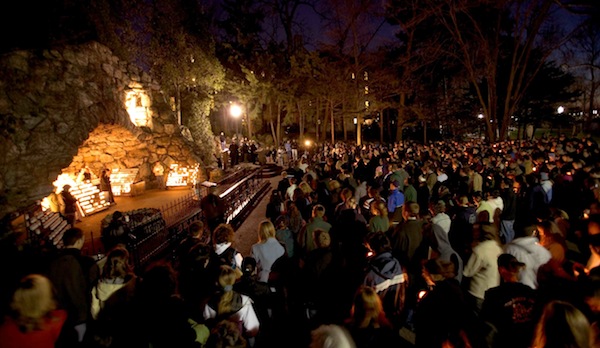
In his later years, John Paul II struggled with Parkinson’s disease. Even though Parkinson's made it difficult for him to celebrate Mass and eventually impacted his mobility, John Paul II did not shy from his public pastoral duties. Thus, John Paul II presented himself to the world as an image of the great humility and dignity of a suffering human being. When John Paul II died in the spring of 2005, the Notre Dame campus community gathered at the Grotto to pray for him and the Church—the image below captures that moment.
Pope John Paul II was beatified in 2011 and was canonized a saint on April 27, 2014, along with Pope John XXIII.
At the University of Notre Dame, John Paul II has been honored by several initiatives and monuments. The Center for Ethics and Culture honors leaders who promote the Gospel of Life with its Evangelium Vitae Medal, which they named after John Paul II’s landmark 1995 encyclical. The image of John Paul II shown above hangs in the Basilica of the Sacred Heart's museum on campus, which also displays several of his white papal zucchettos (the small caps worn by bishops), one of which is pictured below.
Saint Pope John Paul II, who taught us to be not afraid as we open wide the doors to Christ—pray for us!
To learn even more about Saint Pope John Paul II, watch this video lecture from the McGrath Institute for Church Life at the University of Notre Dame.