
Daily Gospel Reflection
Join the Notre Dame family of faith. Receive God’s Word and a unique reflection in your inbox each day.
April 28, 2025
There was a Pharisee named Nicodemus, a ruler of the Jews.
He came to Jesus at night and said to him,
“Rabbi, we know that you are a teacher who has come from God,
for no one can do these signs that you are doing
unless God is with him.”
Jesus answered and said to him,
“Amen, amen, I say to you,
unless one is born from above, he cannot see the Kingdom of God.”
Nicodemus said to him,
“How can a man once grown old be born again?
Surely he cannot reenter his mother’s womb and be born again, can he?”
Jesus answered,
“Amen, amen, I say to you,
unless one is born of water and Spirit
he cannot enter the Kingdom of God.
What is born of flesh is flesh
and what is born of spirit is spirit.
Do not be amazed that I told you,
‘You must be born from above.’
The wind blows where it wills,
and you can hear the sound it makes,
but you do not know where it comes from or where it goes;
so it is with everyone who is born of the Spirit.”
Excerpts from the Lectionary for Mass for Use in the Dioceses of the United States of America, second typical edition © 2001, 1998, 1997, 1986, 1970 Confraternity of Christian Doctrine, Inc., Washington, DC. Used with permission. All rights reserved. No portion of this text may be reproduced by any means without permission in writing from the copyright owner. The full readings of the day from the Lectionary are available here.
I do love it when a character in the Bible asks Jesus a seemingly nonsensical question, as Nicodemus does in today’s reading: Surely, one cannot reenter one’s mother’s womb and be born again, can they?
While the Catholic tradition does not use the phrase “born-again,” I am challenged today to reflect on how I have renewed and continue to grow in my faith. We all know how fruitful it is to update our spiritual practices: attending a retreat, a day of reflection, or adopting a new prayer practice. But how often do we actually say “yes!” to these opportunities?
Despite working with high school students and walking with them on retreats throughout the school year, it has been more years than I would like to admit since I last took a retreat of my own. The Jesuits at the school where I teach offer Mass each day before school, but it is a rare occurrence for Ms. Lyons to find herself in the chapel at 7:45 am. But I am not a lost cause! I did say “yes!” to a new prayer practice recently.
I am now over a month into my very first novena. I have found great peace in the prayers and gratitude for the space to say them each day. I have especially found a new gratitude for the reminder app on my phone, so I never forget to pray!
In what ways might we be called to refresh our faith practices today? It’s never too late for our faith to be born anew.
Prayer
O God, like Nicodemus, we sometimes get confused about what it is you are trying to tell us. We thank you for your patience as you move us into a deeper understanding of your will in our life. Help us to be patient this day with ourselves and with others. Amen.
Saint of the Day
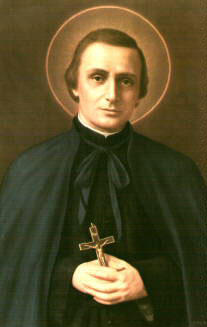
Even though he was born in a small village in the eastern part of France, St. Peter Chanel is the patron saint of Oceania because that is where he was martyred as a missionary.
Peter was born in 1803 in eastern France and was a shepherd boy until the family’s parish priest convinced Peter’s parents to let him attend the small school the priest had just opened. Peter was clearly both smart and faithful, and he was sent to a larger, Church-sponsored school.
There, he read letters from missionaries who had left France and come to America, and he was inspired to follow them. He continued to succeed in school, and entered the seminary.
He was ordained in 1827, and asked his bishop for permission to become a missionary, but the bishop denied his request, assigning him to a parish. Peter applied himself diligently to his ministry—he was known for his zeal and for his care for the sick—and within a few years, the parish was revitalized.
During this time, Peter came into contact with a group of priests gathering into a new missionary order dedicated to Mary. In 1831, he joined these Marists with the hope of finally reaching the missions, but they assigned him to be a spiritual director at a seminary. He stayed there for five years, helping the new order ground itself and receive official recognition.
Then, in 1836, the Marists were asked to send missionaries to islands in the south Pacific. Finally, Peter was allowed to follow his life’s longing, and he set out that year with seven others. After nearly a year’s voyage, Peter settled in Futuna, a small Polynesian island that is now part of the French-administered territory of Wallis and Futuna.
The group was welcomed to Futuna, and Peter set out to learn the local culture. After struggling with the language, he came to master it, and applied patience and courage to the isolation and poverty he met there. Slowly, his mission started to bear fruit among the local people.
Then, Futuna’s king came to fear Peter and Christianity because he saw that it would threaten his power and status. When the king’s own son sought baptism from Peter, the king decided that was enough. He enlisted his leading warrior, Musumusu, to kill Peter, and the soldier took a group of others to attack the missionary. They surprised Peter and clubbed him to death on this date in 1841.
It is said that Peter’s death led to many conversions, and that the whole island adopted Christianity soon after his death. The warrior who led the attack on Peter eventually claimed the faith for his own, and humbly asked that he be buried outside of the church that held Peter’s relics, so that anyone who came to honor Peter would have to walk over his grave to do it. Other relics of St. Peter rest in the reliquary chapel in the Basilica on campus.
St. Peter Chanel, you are patron saint of the south Pacific because you gave your life to bring the faith there—pray for us!
Image Credit: Our featured image of St. Peter Chanel is in the public domain. Last accessed February 13, 2025 on Wikimedia Commons.
