

Daily Gospel Reflection
Join the Notre Dame family of faith. Receive God’s Word and a unique reflection in your inbox each day.
August 16, 2026
At that time, Jesus withdrew to the region of Tyre and Sidon.
And behold, a Canaanite woman of that district came and called out,
“Have pity on me, Lord, Son of David!
My daughter is tormented by a demon.”
But Jesus did not say a word in answer to her.
Jesus’ disciples came and asked him,
“Send her away, for she keeps calling out after us.”
He said in reply,
“I was sent only to the lost sheep of the house of Israel.”
But the woman came and did Jesus homage, saying, “Lord, help me.”
He said in reply,
“It is not right to take the food of the children
and throw it to the dogs.”
She said, “Please, Lord, for even the dogs eat the scraps
that fall from the table of their masters.”
Then Jesus said to her in reply,
“O woman, great is your faith!
Let it be done for you as you wish.”
And the woman’s daughter was healed from that hour.
Excerpts from the Lectionary for Mass for Use in the Dioceses of the United States of America, second typical edition © 2001, 1998, 1997, 1986, 1970 Confraternity of Christian Doctrine, Inc., Washington, DC. Used with permission. All rights reserved. No portion of this text may be reproduced by any means without permission in writing from the copyright owner. The full readings of the day from the Lectionary are available here.
Several months ago, I began visiting people in the county jail with the Saint Dismas ministry as a part of the Society of Saint Vincent de Paul. I felt courageous, hoping I could overcome my biases and judgements to see Christ in the faces of people who have been “sent away” for, in some cases, doing horrible things.
In today’s passage, Jesus is initially silent to the Canaanite woman’s pleas, perhaps so we can observe what his disciples do. Their response reveals their own biases and judgements when they ask Jesus to “send her away.” It illustrates Jesus’ lesson just prior to this: what comes out of our mouths comes from our hearts and defiles.
Then there’s a surprising twist—Jesus calls her a dog! Why does he do this? I suggest that Jesus simply articulated the judgmental thoughts of others. In doing so, he gave the woman a voice and an opportunity to open our eyes to the truth that everyone is worthy of God’s love and mercy.
In contrast to the hardened hearts of the disciples, she demonstrates a persistent and humble heart. Jesus rewards her with the healing she requests and a commendation as well: “Great is your faith.”
In the next scene, Jesus has compassion for a great crowd of Gentiles and feeds them, demonstrating his generous love for all who come to him. I have been blessed through jail ministry to learn that, like me, those I visit are wounded people in need of Jesus’ healing love and mercy. Let us all strive for persistent and humble hearts like that of the Canaanite woman, so with Jesus’ help we can uproot our biases and judgements to better see Christ in everyone.
Prayer
“Lord, help me.” God, all we have to do is call out for help and you are there. That can be hard to do, though, because we don’t want to admit that we need your assistance. But when we ask for your help, whatever troubles us becomes easier. Remind us to ask for your help. Amen.
Saint of the Day
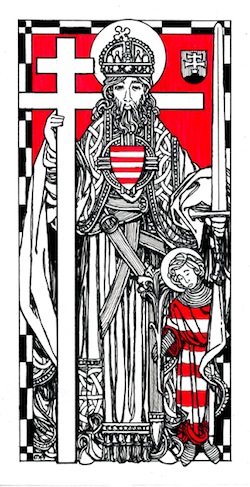
St. Stephen was crowned the first king of Hungary in 1001 and united that nation under Christianity.
He established the Church there, erecting churches and recommending bishops to lead in different regions. He commanded tithes to be paid to support new monasteries and parishes, and suppressed pagan beliefs.
He stayed close to the poor. Anyone could tell him their story and find a ready ear, but he made himself especially available to poor people. In one story, he disguised himself to distribute money and goods to the poor himself. A crowd gathered around him, and a small number roughed him up and took for themselves what he had intended to give to many. He laughed it off, happy to suffer for Christ, and resolved to never refuse support to any poor person who asked him.
His son, Blessed Emeric of Hungary, was to be heir to the throne, but he died in a hunting accident. Stephen was grief-stricken and spent the rest of his life amidst bitter disputes about his succession.
He died from a painful illness in 1038. On his deathbed, he raised his right hand and asked the Virgin Mary to be Queen of Hungarians. His right hand remained incorrupt after his death and is kept intact as a relic. Known simply as the Holy Right, it is kept in Budapest to this day as a sign that Mary accepted his offer.
Shortly after his death, healings took place at the tomb of St. Stephen. He was canonized as the first confessor king—a new category of saint—and his relics are on display in the Basilica.
St. Stephen of Hungary, you cared most for those in need—pray for us!
Image Credit: Image by Notre Dame alumnus Matthew Alderman, who holds exclusive rights to the further distribution and publication of his art. Used here with permission.