
Daily Gospel Reflection
Join the Notre Dame family of faith. Receive God’s Word and a unique reflection in your inbox each day.
August 23, 2026
Jesus went into the region of Caesarea Philippi and
he asked his disciples,
“Who do people say that the Son of Man is?”
They replied, “Some say John the Baptist, others Elijah,
still others Jeremiah or one of the prophets.”
He said to them, “But who do you say that I am?”
Simon Peter said in reply,
“You are the Christ, the Son of the living God.”
Jesus said to him in reply,
“Blessed are you, Simon son of Jonah.
For flesh and blood has not revealed this to you, but my heavenly Father.
And so I say to you, you are Peter,
and upon this rock I will build my church,
and the gates of the netherworld shall not prevail against it.
I will give you the keys to the kingdom of heaven.
Whatever you bind on earth shall be bound in heaven;
and whatever you loose on earth shall be loosed in heaven.”
Then he strictly ordered his disciples
to tell no one that he was the Christ.
Excerpts from the Lectionary for Mass for Use in the Dioceses of the United States of America, second typical edition © 2001, 1998, 1997, 1986, 1970 Confraternity of Christian Doctrine, Inc., Washington, DC. Used with permission. All rights reserved. No portion of this text may be reproduced by any means without permission in writing from the copyright owner. The full readings of the day from the Lectionary are available here.
It was easy for me to go to Mass each Sunday and recite the creeds and prayers, feeling faithful. Yet, I knew that there were still crucial elements of my life I was still holding back from God. I remember my high school conversations being filled with vague nods to the “universe” and Christian-adjacent type language. During those years, I was fearful of the pushback I would get for my faith.
Everything changed when I asked myself one question: Who is Christ to me? I found myself facing a profound disconnect between my Sunday professions and these ordinary weekday conversations. Christ invited me deeper then, first through the sacraments, then in ordinary moments. With much wrestling, yet with much love, I took the leap. Jesus became more and more a part of my conversations, and with that, more and more a part of my relationships and daily practices. Even when my faith led to closed doors and dissolved friendships, I was left with the Lord, and that was enough.
Who is Christ to us? Do we put him above everyone and everything else in our lives? If we profess that Christ is Lord, like Saint Peter so boldly professed, do we truly make him Lord over every aspect of our lives? Do we invite him into our relationships, our habits, our darkest places?
Indeed, are we bold enough to take our professions of faith far from church pews? How prepared are we to prudently and charitably make the same professions before nonbelievers, non-Catholics, and non-Christians?
Though we might not be called to be the next pope, a simple yes in surrender to Christ wherever he is calling us in our lives might be the beginning of sainthood. Do we have the faith to utter that yes?
Prayer
Jesus our teacher, you challenged your disciples to know you more intimately, and so come to recognize you as the Christ. Help us never to be content with our knowledge of you, but always to desire to know and love you more. Bring our hearts to rejoice in Peter’s confession that “You are the Christ”—our salvation and the fulfillment of our lives. Amen.
Saint of the Day
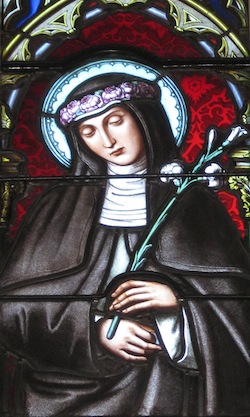
St. Rose of Lima was given the name Isabel when she was born in Peru in 1586. She was such a beautiful baby, however, that people could not help calling her Rose.
Her beauty grew as she aged, and she became the subject of much admiration. She decided to devote herself fully to Jesus, however, and the admiration became a distraction to her. She feared her beauty would distract others as well, so she would rub crushed pepper on her face to produce rashes and blisters.
Her devotion led her to take on severe mortifications, but she was devoted to those around her with similar intensity. When her parents fell into poverty, she worked to grow food in their garden and took on sewing jobs at night. She dedicated a room in her family’s home to care for orphans and the poor.

She wanted to enter a convent, but her parents would not give her permission because they wanted her to marry. She was obedient to her parents and did not join a convent. She did convince them of her vow of virginity, however—she clung to her single-hearted devotion to Christ and remained at home for her whole life, giving herself to prayer and good works. (She became a third-order Dominican, meaning that she took on the spirituality of the Dominicans as a private lay person.)
She is the patron of the Americas, the Philippines, and of florists. She is depicted, among other places, in a mural and in a window in the Basilica, wearing a crown of roses, and a number of her relics are kept in the reliquary chapel in the Basilica.
St. Rose of Lima, your beauty transcended your body as you stubbornly sought holiness—pray for us!
To learn even more about Saint Rose of Lima, watch this video lecture from the McGrath Institute for Church Life at the University of Notre Dame.