

Daily Gospel Reflection
Join the Notre Dame family of faith. Receive God’s Word and a unique reflection in your inbox each day.
August 25, 2026
Jesus said:
“Woe to you, scribes and Pharisees, you hypocrites.
You pay tithes of mint and dill and cummin,
and have neglected the weightier things of the law:
judgment and mercy and fidelity.
But these you should have done, without neglecting the others.
Blind guides, who strain out the gnat and swallow the camel!“Woe to you, scribes and Pharisees, you hypocrites.
You cleanse the outside of cup and dish,
but inside they are full of plunder and self-indulgence.
Blind Pharisee, cleanse first the inside of the cup,
so that the outside also may be clean.”
Excerpts from the Lectionary for Mass for Use in the Dioceses of the United States of America, second typical edition © 2001, 1998, 1997, 1986, 1970 Confraternity of Christian Doctrine, Inc., Washington, DC. Used with permission. All rights reserved. No portion of this text may be reproduced by any means without permission in writing from the copyright owner. The full readings of the day from the Lectionary are available here.
As a former elementary teacher, I know how important birthdays are to children. At the beginning of each school year, I received a list of the birthdays in my class. On each child’s special day (or half-birthday, for summer birthdays), their name was announced over the loudspeaker during morning announcements, our class sang them “Happy Birthday,” and they got to walk down to the principal’s office for a birthday sticker. Many students counted down to their birthdays, walking through the classroom door and reminding me, “Only three more days until my birthday, Ms. Winsch!”
When I started a new job teaching undergraduate students this past fall, I didn’t receive a list of birthdays for all my students, but I didn’t think anything of it. I was too busy revising my syllabi, uploading readings to Canvas, and preparing my course materials. And college teaching felt far too serious for birthday celebrations anyway.
In my first semester of this new job, I got married. Right before my wedding, I walked into class and started setting up when one of my students asked, “Dr. Winsch, do you notice anything different?” I looked around the room. My students had set up a surprise bridal shower for me– complete with a banner, cupcakes, and a card signed by each of them.
In today’s gospel, Jesus says, “You pay tithes of mint and dill and cummin, and have neglected the weightier things of the law: judgment and mercy and fidelity. But these you should have done, without neglecting the others.” In their thoughtfulness, my students reminded me to keep the weightier things in view—alongside the curriculum, the assignments, and the learning objectives, there is always time to make those in front of you feel seen, known, and loved. No class is too serious for that.
Prayer
Lord God, your Son walked among us flawed human beings. He loved the poor, the sick, and the widowed. He delighted in little children. He sat at table with men and women who were sinners and called them to new life. Only hypocrisy raised anger in Jesus. Open our eyes and hearts to see ourselves as we are and to cast ourselves upon your mercy rather than to cover our shame with lying to ourselves and to those around us. Amen.
Saint of the Day
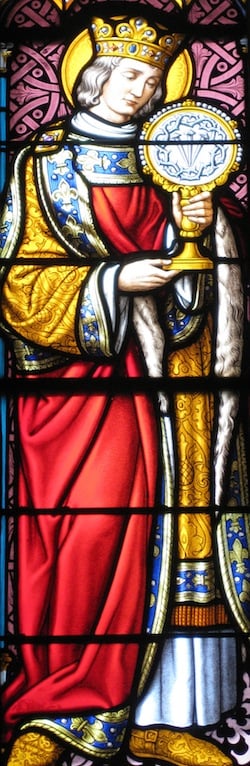
Stories about the holiness and justice of St. Louis IX, the famed good king of France, have become legendary. Because the priests and brothers who founded Notre Dame were from a French religious community, the Congregation of Holy Cross, he is abundantly depicted in the Basilica of the Sacred Heart on campus.
Louis was born in 1214, and his mother took great care to raise him in the faith and instill virtue. “I love you, my dear son, as much as a mother can love her child,” she would say to him, “but I would rather see you dead at my feet than that you should commit a mortal sin.”
When Louis was 12 years old, his father died, which left Louis in line to become king. As he was a minor, his mother acted as his regent, assisting him with decisions until he grew older. Still, Louis displayed remarkable maturity—he was merciful to rebels and did not seek revenge; he loved the Church and sought the conversation of priests and religious (including St. Thomas Aquinas); he diligently sought the truth in any case he was asked to judge, even when bishops were involved; and he banished from court any immoral activities. “I was a good 22 years in the holy king’s company,” wrote his biographer, “and never once did I hear him swear, either by God or his Mother or the saints.”
Louis married when he was 19—he and Margaret had a happy marriage and produced 11 children. Their offspring produced the line of kings and queens who ruled France for 500 years, until the Revolution.

When Louis turned 21, he assumed control of the government for himself, and continued to shape France into a faithful nation. He founded a number of monasteries and churches, the most prominent of which was Sainte Chapelle, famous for its stained glass windows and built to hold Jesus’ crown of thorns. (The relic was given to him as a gift for his support of Christians in the Holy Land, and he tore down his own chapel to make room for a church to venerate it. He is shown in this stained glass window bringing the crown of thorns to France—he is carrying it in a bare-footed procession.)
He forbade moneylending, and legislated that anyone caught lying be branded (and did not shy from using the law to punish a prominent citizen of Paris). He kept his word scrupulously, and many foreign kings and nobility asked for his help in judging matters because they trusted his integrity.
He had a passion for justice, transforming the king’s court into an efficient and organized court for justice. He was careful to protect subordinates from their feudal lords—for example, when a count hanged three children for hunting in his woods, Louis had him arrested and tried. The count demanded a trial by his peers, but Louis insisted he be subject to ordinary judges, who condemned him to death. Louis prevented his execution, but fined him so excessively that the count lost most of his land; the money was put towards charitable works.

Louis is remembered for his personal holiness as well as for his faithful leadership. Among the institutions he created to assist the poor, he founded a hospital for the blind in Paris. Every day, he invited 13 homeless people to eat with him personally; this was in addition to the large number fed daily by the palace. In Lent and Advent, he invited anyone who was hungry to dine with him, and often served them himself. He also kept a list of people in special need, whom he looked after and supported.
When Muslim forces conquered the Holy Land, Louis promised to return it to Christianity and led two crusades to win it back—both failed. In the first crusade, which lasted for six years, he was taken prisoner for a time before returning to France upon his mother’s death. He remembered the distress of the Christians there, though, and wore a cross on his clothes to signify his intent to return. In 1270, he set out again to the Holy Land, but soon after landing there, he fell sick with typhus and died.
Relics of St. Louis IX rest in the Basilica, and he is shown there in these stained glass windows. The window that shows him processing with the crown of thorns stands in the reliquary chapel in the Basilica, which also holds parts of Jesus’ crown of thorns.
St. Louis, the good king of France, you led your people with faithfulness and justice—pray for us!