

Daily Gospel Reflection
Join the Notre Dame family of faith. Receive God’s Word and a unique reflection in your inbox each day.
August 26, 2026
Jesus said,
“Woe to you, scribes and Pharisees, you hypocrites.
You are like whitewashed tombs, which appear beautiful on the outside,
but inside are full of dead men’s bones and every kind of filth.
Even so, on the outside you appear righteous,
but inside you are filled with hypocrisy and evildoing.
“Woe to you, scribes and Pharisees, you hypocrites.
You build the tombs of the prophets
and adorn the memorials of the righteous,
and you say, ‘If we had lived in the days of our ancestors,
we would not have joined them in shedding the prophets’ blood.’
Thus you bear witness against yourselves
that you are the children of those who murdered the prophets;
now fill up what your ancestors measured out!”
Excerpts from the Lectionary for Mass for Use in the Dioceses of the United States of America, second typical edition © 2001, 1998, 1997, 1986, 1970 Confraternity of Christian Doctrine, Inc., Washington, DC. Used with permission. All rights reserved. No portion of this text may be reproduced by any means without permission in writing from the copyright owner. The full readings of the day from the Lectionary are available here.
Truth be told, when I discovered this was the Scripture reading that I agreed to reflect upon, I was not jumping for joy. The entire 23rd chapter of the Gospel according to Matthew is a tough one. Jesus delivers a lengthy critique regarding the hypocrisy of the scribes and Pharisees, the leaders of the Jewish people in his day.
In his critique, Jesus outlines seven woes, or rebukes, to the evil leaders. Today’s reading contains the last two of the seven woes. In the sixth woe, Jesus warns against focusing only on outward appearances versus cultivating an inner heart of love and mercy. In the seventh woe, Jesus calls them out for claiming they would not have killed the prophets of the past as their ancestors did, yet they are plotting to kill the prophet of their day, Jesus.
I am challenged when I seek to understand how this Scripture passage relates to my life and what I am to learn from it. It’s easy to read through this list of seven woes and conclude they were only relevant to people very different from me who lived a long time ago in a place very far away. But digging a little deeper and reflecting a little longer, I find myself looking in the mirror. What masks do I wear to make people think I’m something I want to be but may not actually be? What boxes do I check, hoping people won’t ask anything beyond what I’m already comfortable doing? In what ways do I judge others when I’m guilty of the same actions myself?
Being vulnerable and honest with oneself and with others is hard. I pray for God’s grace to purify my own heart, to draw me closer to him, and to help me live more authentically and courageously as the person I really am.
Prayer
Jesus, living in Mary, come and live in us, by the spirit of holiness, the fullness of your power, the truth of your virtues, and the communication of your mysteries. Triumph over all hostile powers by your spirit, for the glory of God. Amen.
Saint of the Day
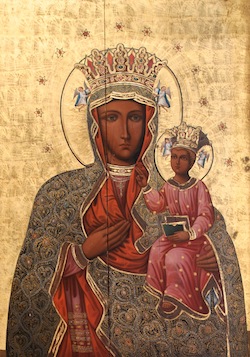
Our Lady of Czestochowa is an image of Mary located in Poland. The icon is also known as the Black Madonna because the image has darkened from the soot of so many votive candles burning near it. Czestochowa is one of the most popular pilgrimage sites in Poland—many people visit the shrine to venerate Mary in this icon.
Tradition holds that the icon was painted by St. Luke upon wood that had been part of the table in the home of the Holy Family. It is said that the image was kept in royal palaces in Constantinople and Ukraine after St. Helen found it in Jerusalem. It came to Czestochowa in 1382 by way of a nobleman who was escaping an attack in Ukraine—he stopped to rest in the town and entrusted it to a monastery there.
In 1430, robbers looted the monastery and stole the image. In trying to remove precious stones from the icon, they smashed the wood and made slashes in the paint. When the icon was restored, the artists retained the slashes that were made on Mary’s face.
In the image, Mary’s hand points to Jesus, as she did with her whole life. Jesus holds a book of the Gospels in one hand and extends the other to the viewer in a blessing.
The image is associated with a miracle that marked a turning point in a war between Poland and Sweden in 1655. Monks and other people in the monastery were severely outnumbered by the invading Swedish forces but managed to repel the attackers with the miraculous intervention of Mary.
The image also played a large role in the devotional life of the young St. Maximilian Kolbe; he experienced a moment of conversion as a boy when he was praying in front of this image, and the experience shaped the rest of his life.
A replica of the Our Lady of Czestochowa image stands in the Basilica of the Sacred Heart, and it faithfully reproduces even the slash marks on Mary’s face. The image was a gift to Father Edward Sorin, C.S.C., founder of Notre Dame, from the Polish Carmelite Sisters in the Shrine of St. Bridget in Rome. The sisters gave it to Father Sorin, who was superior general of the Congregation of Holy Cross at the time, “as a sign of perpetual friendship.”
Our Lady of Czestochowa, you are captured in the miraculous image of Mary venerated by Polish people—pray for us!
Personalize and share a prayer card with this image of Our Lady of Czestochowa at our prayer card page.