
Daily Gospel Reflection
Join the Notre Dame family of faith. Receive God’s Word and a unique reflection in your inbox each day.
May 2, 2026
Jesus said to his disciples:
“If you know me, then you will also know my Father.
From now on you do know him and have seen him.”
Philip said to Jesus,
“Master, show us the Father, and that will be enough for us.”
Jesus said to him, “Have I been with you for so long a time
and you still do not know me, Philip?
Whoever has seen me has seen the Father.
How can you say, ‘Show us the Father’?
Do you not believe that I am in the Father and the Father is in me?
The words that I speak to you I do not speak on my own.
The Father who dwells in me is doing his works.
Believe me that I am in the Father and the Father is in me,
or else, believe because of the works themselves.
Amen, amen, I say to you,
whoever believes in me will do the works that I do,
and will do greater ones than these,
because I am going to the Father.
And whatever you ask in my name, I will do,
so that the Father may be glorified in the Son.
If you ask anything of me in my name, I will do it.”
Excerpts from the Lectionary for Mass for Use in the Dioceses of the United States of America, second typical edition © 2001, 1998, 1997, 1986, 1970 Confraternity of Christian Doctrine, Inc., Washington, DC. Used with permission. All rights reserved. No portion of this text may be reproduced by any means without permission in writing from the copyright owner. The full readings of the day from the Lectionary are available here.
I will be honest. The mystery of the Holy Trinity has always filled me with a kind of reverent curiosity and also confusion. Father, Son, and Holy Spirit: three Persons, one God. My mind cannot fully hold it. And yet, this passage opens a small window into that breathtaking mystery, and just like Philip, I find myself wanting more.
Philip asks for what I so often want myself—something concrete. “Show us the Father.” It is the request of someone straining toward God with everything he has, but not yet seeing clearly. Jesus meets him—meets all of us—not with frustration, but with an astonishing claim: you have already seen the Father, because you have seen me.
The invisible God is made visible in the person of Jesus Christ. Father and Son are not merely aligned in purpose. They dwell within each other. This is not poetry. This is the deepest reality of existence.
As someone still growing in my Catholic faith, I am learning to sit with mystery rather than demand that it resolve itself on my terms. The Trinity is not a puzzle to be solved. It is a communion to be entered. And Jesus invites exactly that. Believe, act, ask in his name. We are not left as awestruck bystanders. Through baptism, we are drawn into that very communion as sons and daughters of the Father, brothers and sisters of the Son, alive in the Holy Spirit.
What an extraordinary thing it is to be Catholic.
Prayer
God of all wisdom and grace, fill us with zeal to proclaim the truth of our faith wherever your Spirit leads us. Give us courage and determination to live out our faith in a challenging world. May our lives reflect your radiance as you lead us into your promise of everlasting life. We ask this through Christ our Lord. Amen.
Saint of the Day
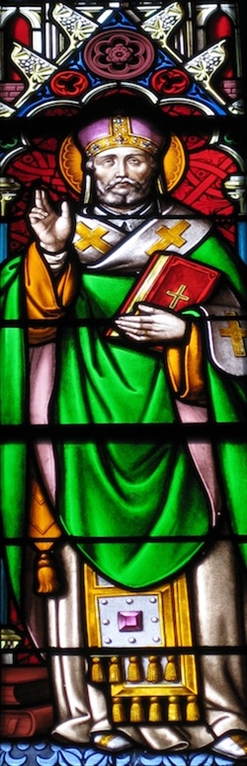
St. Athanasius applied his heart and mind to articulating Jesus' divinity and humanity and faced exile for his work, which helped shape the way the Church understands this mystery.
He was born in 297 in Alexandria, Egypt, at the end of the Roman persecution of Christians and at the start of the ascension of the Emperor Constantine. His parents were Christians, and he received an excellent education. He learned the Scriptures inside and out, and for a time he followed St. Anthony the Great, who established a life of prayer in the desert.
Athanasius was ordained a deacon at the age of 21 and was assigned as a secretary to the bishop of Alexandria. It was in this role as an aid to the bishop that Athanasius attended the great council of Nicea, which gave us the Nicene creed that we still recite at Mass today.
The council was called because of the rapid spread of a strain of thought—named Arianism, after its first teacher, Arius—which claimed that because Jesus was born as a man, he could not have existed before his birth, and therefore was not fully divine. The council definitively stated that Jesus was, in fact, divine, and had existed as part of the Trinity before the Incarnation. The bishops condemned Arius and articulated the creed as a standard of orthodoxy.
Shortly after the council, the bishop died, and Athanasius was appointed his successor, even though he was not even 30 years old. Arianism, despite its condemnation, was still a popular belief, and Athanasius spent most of the rest of his life dealing with that heresy.
He steadfastly proclaimed the conclusions of the council, even in the face of threats. His Arian opponents accused him of treason and even murder. Because they had connections to powerful people in the empire, they succeeded in having Athanasius removed and exiled. Political maneuvers resulted in his restoration and exile several more times—by the end of his life, he had been banished five times and spent 17 years in exile. He was a constant thorn in the side of the powerful who wanted a more convenient version of Christianity, and for this reason was called the “Champion of Orthodoxy.”
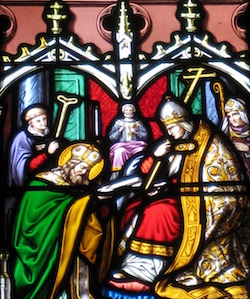
Athanasius was known as the greatest man of his day, and is one of the greatest religious leaders the world has ever known. He defended the faith when everything seemed stacked against him, and without his steadfastness, we would not have received the fullness of the faith that we have today. The Church recognizes him as one of her doctors, and his relics rest in the reliquary chapel in the Sacred Heart Basilica on campus. He is depicted there in stained glass windows, including one with an image showing him faithfully handing on doctrine, in the form of a scroll, to the Church.
St. Athanasius, against all odds, you preserved and passed on the fullness of our faith in Jesus—pray for us!