

Daily Gospel Reflection
Join the Notre Dame family of faith. Receive God’s Word and a unique reflection in your inbox each day.
August 24, 2021
Philip found Nathanael and told him,
“We have found the one about whom Moses wrote in the law,
and also the prophets, Jesus son of Joseph, from Nazareth.”
But Nathanael said to him,
“Can anything good come from Nazareth?”
Philip said to him, “Come and see.”
Jesus saw Nathanael coming toward him and said of him,
“Here is a true child of Israel.
There is no duplicity in him.”
Nathanael said to him, “How do you know me?”
Jesus answered and said to him,
“Before Philip called you, I saw you under the fig tree.”
Nathanael answered him,
“Rabbi, you are the Son of God; you are the King of Israel.”
Jesus answered and said to him,
“Do you believe
because I told you that I saw you under the fig tree?
You will see greater things than this.”
And he said to him, “Amen, amen, I say to you,
you will see heaven opened and the angels of God
ascending and descending on the Son of Man.”
Excerpts from the Lectionary for Mass for Use in the Dioceses of the United States of America, second typical edition © 2001, 1998, 1997, 1986, 1970 Confraternity of Christian Doctrine, Inc., Washington, DC. Used with permission. All rights reserved. No portion of this text may be reproduced by any means without permission in writing from the copyright owner. The full readings of the day from the Lectionary are available here.
We are all familiar with the embarrassment that comes from making a hasty, erroneous judgement about someone. In today’s gospel, we see Nathanael fall prey to this human impulse to rush to judgement. Nathanael, blinded by his low opinions of Nazareth, is only convinced upon meeting Jesus and understanding why Philip is so amazed.
While this is a small story in the larger narrative of John’s Gospel, it holds particular importance for our daily attempt to live the faith. We all share Nathanael’s impulse to rush to judgement, and perhaps we are even more susceptible to it today thanks to social media and our hyperconnected world. In our stereotypes and assumptions, we too fail to recognize the Messiah in our lives.
We must remember that what we do to the least of our brothers and sisters, we do to the Lord as well. For instance, do we refuse to aid the homeless because we quickly judge them as deserving of their situation? Or do we have a poor opinion of people from a certain geographic area instead of recognizing their inherent dignity?
Christ’s life in Nazareth, his willingness to minister on the margins of society, and his death upon the cross show us that he is present in even the most undignified of scenarios. Thus, let us pray to the Lord to temper our snap judgements and ask for his grace in seeing his presence in our lives.
Prayer
In your goodness, O Lord God, you chose Bartholomew to follow in the footsteps of your Son. In so doing he became his disciple and intimate friend in the founding of the early Christian Church. Inspire all your Christian people today to live in such a way that they too can be called disciples of Jesus in the building of his kingdom on earth. We ask this through Christ our Lord. Amen.
Saint of the Day
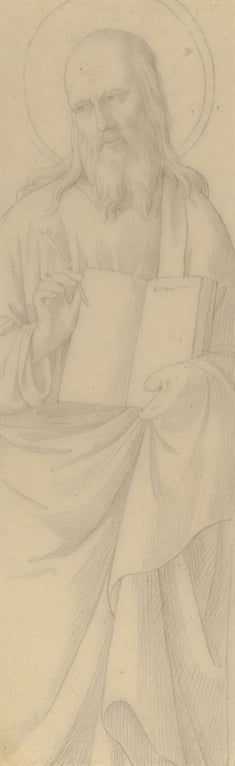
There is a fascinating, roundabout story in how Bartholomew came to be one of the twelve disciples:
Jesus walked by his cousin, John the Baptist, who encouraged two of his own followers to follow Christ. One of those two was Andrew, who went and found his brother, Simon Peter. Andrew and Simon Peter had a friend from their hometown, Philip, so Jesus went there to speak to him. Philip told his friend, Bartholomew, that he had found the messiah, and Bartholomew encountered Jesus for himself and confessed him as the Son of God (John 1).
Isn’t this how human beings work? When we find something important, we recommend it to our friends. Today, we “like” something or reshare it on social media.
As Bartholomew experienced, however, nothing replaces a face-to-face encounter—it was only when he met Jesus for himself that he believed.
Bartholomew’s personal encounter with Christ changed him so fundamentally that he traveled as far as India to tell others about Jesus. He was willing to even die for this faith: he was flayed alive before being beheaded.
Jesus assembled his followers by diving into a network of relationships. He continues to do this today—he continues to call us within the relationships of our own lives. Let us be open to that call from others and respond, as Bartholomew did, by seeking a one-on-one encounter with Christ.

St. Bartholomew is depicted in stained glass in the Morrissey hall chapel; the knives are a sign of his martyrdom (he was skinned alive and beheaded). His relics rest in the reliquary chapel in the Basilica, and this illustration of him is held by the Raclin Murphy Museum of Art. He is patron of those with neurological diseases, butchers and leatherworkers.
In the Gospels of Matthew, Mark, and Luke, Bartholomew is always shown accompanying Philip; the name Bartholomew does not appear in the Gospel of John, but tradition holds that he is called Nathaniel in that Gospel because Nathaniel is shown in the company of Philip.
St. Bartholomew, you found Christ through your friends, pray for us!
Luigi Gregori (Italian, 1819-1896), Saint Bartholomew (after Perugino), n.d., black chalk on tracing paper. Raclin Murphy Museum of Art: Gift of Luigi Gregori, AA2009.056.297.